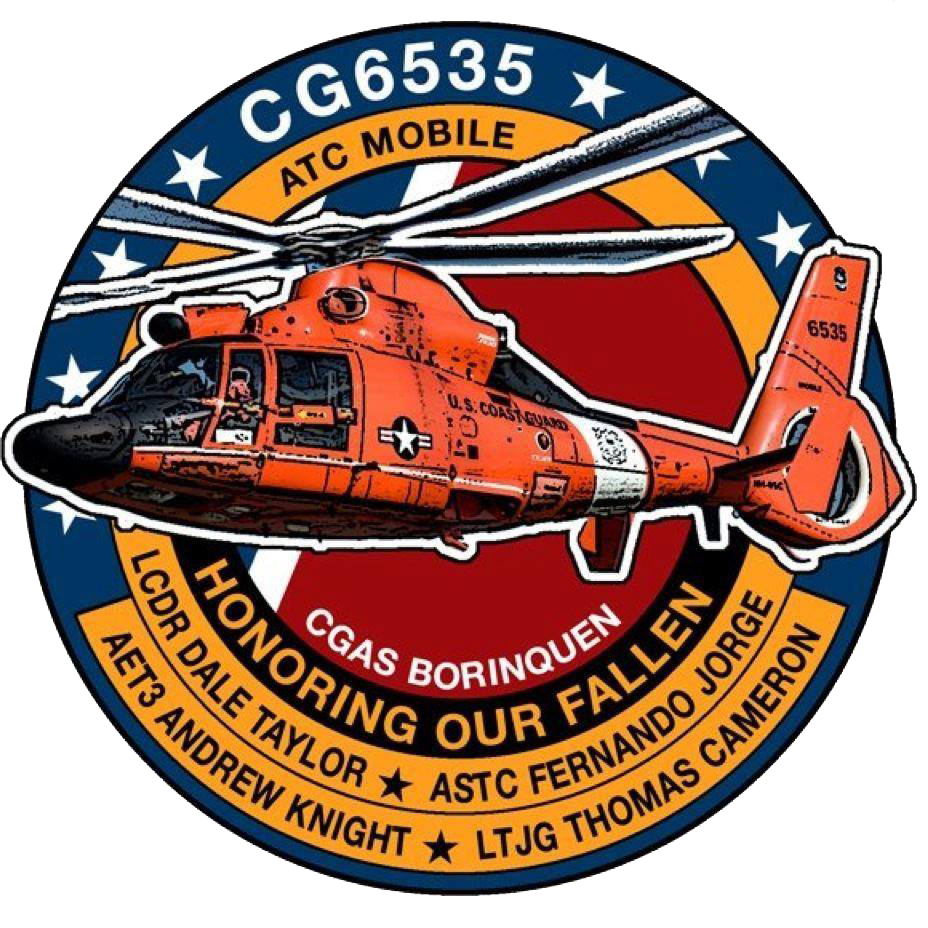
CG6535
February 28th, 2012
I’m jolted awake by my phone’s alarm and have no idea where I am. I was in a deep sleep, and I’m in a strange bed. It takes a minute to piece everything together, but I remember I am in a barracks room at Coast Guard Training Center Yorktown, Virginia. Air Station Borinquen has sent me here to the Occupational Safety and Health Training Course as part of my new safety job at the unit.
When I grab my phone to turn my alarm off, I notice it’s February 29, 2012, a leap year. I don’t have much time to get ready for class, but I notice that while my phone was on silent, I received nearly a hundred text messages.
I sit up, rub my eyes, and start trying to piece them together. My heart starts to race, and I feel more and more sick as I begin to unravel last night’s events. There are texts about a flight. People are mentioning the bad weather in Mobile. A lot of people are asking if I have heard anything. Some texts mention Thomas Cameron being on the flight. As I learn what happened, I crumble right there on the side of the bed, and in this moment of despair, the only thing I think to do is call Natalie.
She answers right away.
“Hey, nene.”
I can barely get anything out. “Hey.”
“What’s wrong?”
I choke out the hardest words I’ve ever had to say. “Last night, there was a helicopter crash in Mobile, and they think Thomas is dead.”
I can hear her fall apart, and she starts rattling off questions. I don’t know much right now. All I can gather from the texts is that the weather was bad, the helicopter crashed, and the wreckage doesn’t look survivable. They have found the rescue swimmer, Fernando Jorge, deceased and are still actively searching for the rest of the crew.
I have totally broken down, and Natalie is sobbing, but then I realize I need to get to my first class. I try to console her as best as I can but explain that I need to go. Somehow, I do what I have been trained to do. I momentarily compartmentalize the fact that I have lost my friend, get ready, and show up to class on time.
A class that absolutely doesn’t matter.
I arrive just as the class is starting and take my seat. The instructor begins.
“Before I get started, you may have heard by now that there has been a Coast Guard helicopter crash in Mobile Bay. If any of you have been impacted by that, please know you can step out, and we can find someone for you to talk to.”
Nearly everyone in the class turns and looks at me because I am the only aviator in the room. I nod and do nothing, deciding to gut out the class.
We are going over important things like inspection requirements for fire bottles and how much clearance circuit breaker panels need. I am not listening to anything. I bounce between staring blankly while spiraling inside and checking my phone for updates or messages. I am constantly receiving texts about what happened, and I still don’t know who else was on the aircraft. I fear the worst thinking about all the legends I know in Mobile, pilots I have looked up to for years.
The teacher is droning on in the background, painstakingly going over PowerPoint slides while people ask useless questions for the sake of hearing themselves talk. I am trapped in OSHA hell as the world of Coast Guard aviation is falling apart.
I dread every break in the class. Since I am the only aviator there, everyone finds me during the breaks to ask what happened and what I know. I can’t talk about any of it, so I just tell them I don’t know.
Just before lunch break, I get another text, and my fear comes true. Dale Taylor was the instructor pilot on the flight. I flash back to meeting him while he was fully committed to his Ladies Man bit and flying with him to the Superdome. I immediately move to denial.
I refuse to believe it’s Dale.
I ask around more because I’m convinced it’s misinformation. Dale is the best pilot I know. He climbed into the back of a helicopter and was deployed to the water in a hurricane to save someone. It is not possible that he would crash on a training flight in Mobile Bay. I need to know it’s not Dale, because if he can be in a crash, none of us are safe. Sadly, each new piece of information confirms that it’s Dale, and reluctantly, I have no choice but to accept it.
I eat lunch in my room by myself because I don’t want to keep talking about the crash with people who don’t understand. I feel isolated and sad, and I would give anything to be back in Puerto Rico. I have a hard time eating anything and eventually head back to class. The class is painful, but at least it forces me to stay moving and not be alone in my room with my thoughts.
After class, I call Duby, and we talk about what happened. It’s nice to talk to someone who understands. Duby has earned his wings and is now stationed at Air Station Miami, but during our conversation, we realize he happens to be at a three week school in Norfolk. He decides he is going to drive up the next day so we can have dinner together. We both need each other right now, and it gives me something to look forward to.
That night is lonely and awful. I talk to Natalie most of the night, and she is having a rough time. I feel terrible that I am not there with her. When I attempt to sleep, it is impossible. I try to imagine that somehow Dale and Thomas have survived and will be found alive, but I know they are gone.
I replay all the memories of Thomas and Dale in my head. I have so much regret that I didn’t spend that last night with Thomas at SanSe. I listen to the voicemail he left me, and it still makes me smile through all the tears. He has so much energy, passion, and excitement for the life he has yet to live, a life cut all too short. I still can’t believe this will be the last time I hear Thomas’s voice. My regret is only interrupted by fear. I am afraid to fly and don’t know if I can go back to being a pilot. Dale honored his profession. He was the epitome of a professional pilot, and he is probably dead. All of the studying and hard work I have been doing doesn’t matter, because all it takes is one mistake and I could be gone.
After the National Guard crash, I remember telling Natalie that it could never happen to me, and now I am struggling with what I am going to tell her because I don’t know what to believe.
The next day, I wake up after a terrible night’s sleep and head into class for my OSHA fueled torture. I sit in class again for hours, numb and scared. Throughout the day, I learn that they have found the bodies of Thomas and Dale, and any small sliver of hope I still had is gone.
It is real.
I feel trapped in this classroom, exiled from my fellow aviators, and I can’t wait to go home.
After class, I get a call from Anthony Guido. He is in rough shape. I didn’t realize it, but he had flown over from Air Station New Orleans the day before and spent all day searching in Mobile Bay. He searched for our friends while circling over the wreckage of the very same helicopter they were sitting in. He explains that the tail of CG6535, with its unmistakable orange Fenestron, is sticking up out of the water, ever present in his search area.
I know he was hoping for a miracle that never came. I feel terrible for him, and I can’t imagine the pain he is in.
I admit that I am scared, and he is too. We talk for a while about everything, and it is emotionally raw, but I need to get it out, and I know he understands. I don’t know what I would do without Anthony. Despite all the loss, pain, and overwhelming fear, I don’t feel so alone when I talk to him.
That night, Duby arrives, and we go out to dinner. We talk a little bit about what happened, but I am afraid of having a total breakdown in the middle of the restaurant, so we don’t get too deep.
We don’t need to.
All I need is to be there with Duby, with one of my best friends, knowing that no matter what, we will always have each other. I feel so lucky that Duby somehow was in Virginia at the same time and drove over an hour to see me. I will always be grateful for this time with him when I needed him the most.
A few days later, I finally make it back to Puerto Rico. It feels good to be back with Natalie, and she does a great job taking care of me, but I know she is scared, and I can’t tell her that I’m scared too. I try to stay busy over the weekend and actually look forward to going back to work to be around my friends. The thought of turning in my wings and not flying anymore constantly haunts me. I have already seen so much death that it doesn’t seem worth it.
Once I finally make it into work, I can’t help but notice how normal everything seems. All our helicopters are lined up in the hangar, with maintainers crawling all over them. Non duty training flights have been canceled for a few days, but the duty crews are still launching.
A part of me is angry and thinking, Doesn’t anyone see that we lost Thomas and the rest of that crew? We should shut everything down and be mourning. How dare you continue on like nothing happened?
Then, the more I think about it, the more I start to feel a sense of pride.
I realize that this is what the Coast Guard does. Coast Guard aviation has had a presence in Puerto Rico since 1947. For more than 60 years, Coast Guard crews in Puerto Rico have stood duty, launched when called, and carried the mission forward. Since 1790, when the Revenue Cutter Service began what would eventually become the Coast Guard, crews have stood the watch and stayed Semper Paratus.
Now, as I think about Thomas and Dale, I realize it would be inappropriate to shut everything down and mourn them by stopping the mission. We need to honor them by continuing the watch.
The hard part about being back at work is the constant reminders of Thomas. When I change into my flight suit, I notice his locker still there with some of his things in it. I walk past his desk and can picture him there with a huge dip in, smiling at everyone who walks by. I see his name still on the whiteboard for scheduling. His memory is still very much a part of the hangar.
At some point during the day, I find myself thinking about how I don’t want to get back in that helicopter and fly again, but then I wonder what Thomas would want me to do. The answer is unmistakably clear and right in front of me.
I remember Thomas surfing and can see him in my mind going after dangerous waves he would never catch, only to be absolutely pummeled into a shallow reef. He didn’t get scared and walk off the beach. When things weren’t going his way and it got hard, he picked himself up, paddled right back out, and did it with a smile. He took beating after beating and kept showing up, and that is exactly what I need to do.
I look around at all the other pilots, and I know they are scared too. We are all thinking the same thing, but they are still flying. Nobody has quit.
Not only do I want to honor Thomas and Dale, but I know if I don’t fly, the rest of the pilots will have to carry my weight. I can’t bear the thought of my friends, who have all been affected by this tragedy, having to do more because of me. I decide at that moment to keep flying.
On the morning of March 7, the Air Station gets a report that there are 11 migrants stranded on Monito. Monito is a small, uninhabited island about 50 miles off the coast of Puerto Rico, a tiny piece of limestone that juts abruptly out of deep blue water. The top is only a small plateau, with no shelter, low shrubs, and sheer cliffs rising more than 100 feet along every side.
Migrants are sometimes abandoned at the base of the cliffs and forced to climb the rugged terrain. The only way to get off the island safely is by helicopter. By the time we are notified, the migrants have been there nearly 24 hours. They are tired, hungry, dehydrated, and desperately want to get off the island.
The duty crew is sent out, and the Operations Officer asks me if I can be on a second crew. There is still plenty of fear lingering, but I know what I need to do. I know what Thomas would do. There are people out there who need me, and they need me to be brave.
I agree to fly the mission, and less than a week after learning Thomas and Dale are dead, I am strapping into the cockpit. There has been no memorial, no discussion about how I’m feeling, and certainly no closure. As I am getting airborne, Coast Guard crews are still in Mobile searching for Drew Knight, the last remaining crew member from CG6535.
I bury everything, like I have done so many times before, ignore my doubts and fears, and just imagine myself paddling back out with a smile on my face.
As we arrive over Monito, chaos ensues. The small island is a seabird sanctuary, and what feels like every nesting seabird on the island becomes airborne to challenge the approaching helicopter. As I look up through the rotor blades, the sky is nearly obstructed by giant seabirds, and all we can do is hope they don’t decide to fly into our helicopter. It looks like a scene from a horror movie.
We hoist two women who are in pretty rough shape and leave food, water, and blankets for the remaining survivors, who will be picked up shortly by the next helicopter. We fly back home, somehow managing to avoid all the birds, and I am proud that I was afraid but went anyway.
The next day, as Coast Guard men and women mourn the crew of CG6535, Dale, Thomas, Fernando, and Drew, I am back on duty. I keep telling myself that I am honoring them by standing the watch, and it is partly true, but part of me is also hiding because I can’t face their families or sit in a hangar full of grieving loved ones and pretend that I’m doing okay. All I know is that I need to stand duty, and the only way forward is to keep flying in that helicopter.
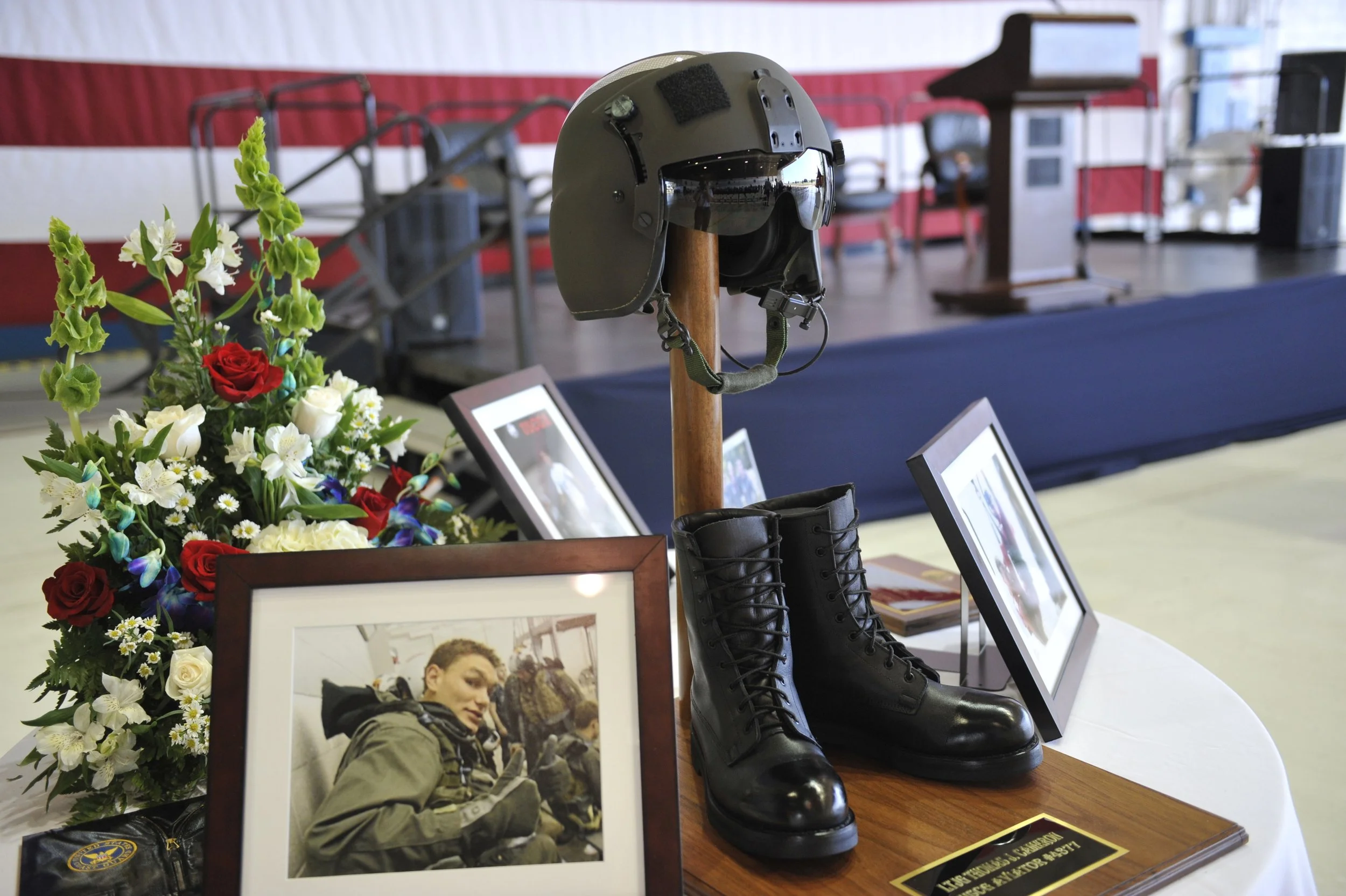
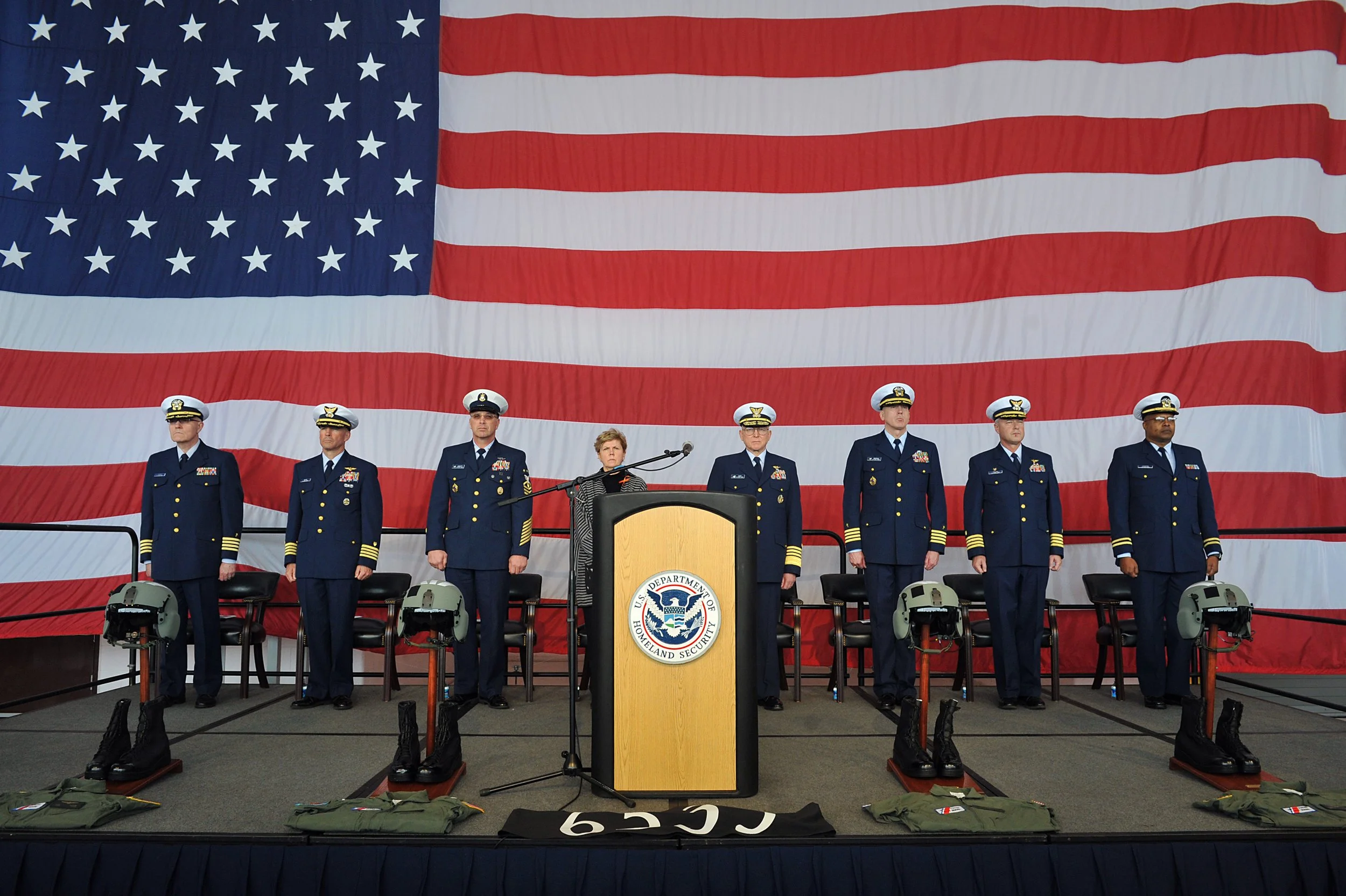
A week later, on March 16, we have a memorial at Air Station Borinquen, and Ryan Ramos delivers a heartfelt eulogy. I am proud of him for standing up there and honoring Thomas with such incredible words. There is some sense of closure after having this memorial, but this wound never properly heals.
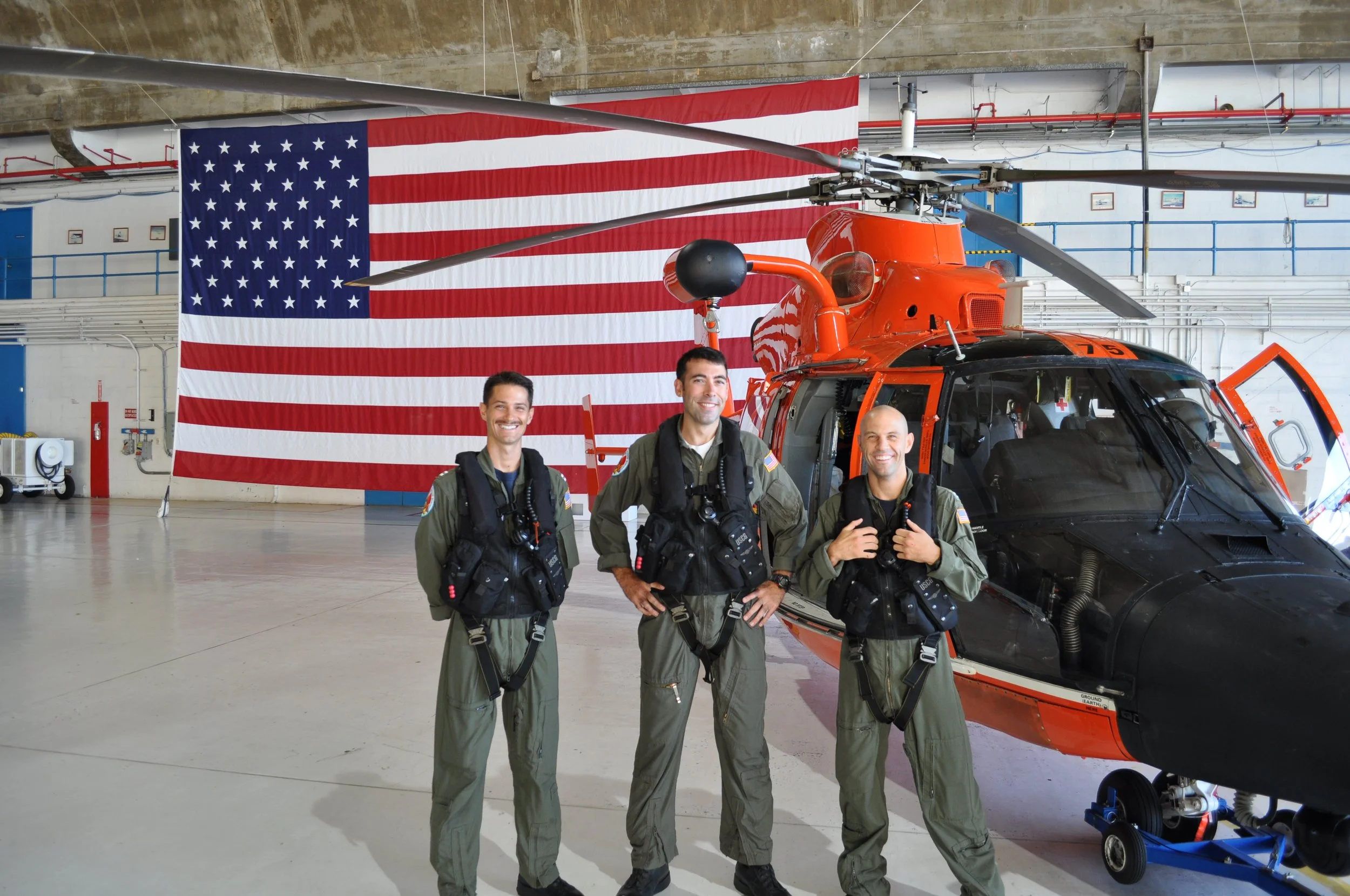
The very next day, Ryan and I are scheduled to take a helicopter to an airshow in San Juan. Before we go, we take some photos in front of the giant American flag and our helicopter, the same flag that was hung for Thomas’s memorial. We spend seven hours on the ramp at Isla Grande Airport with hundreds of people climbing in and out of our aircraft and taking photos with us. Despite how much we are grieving, we manage to show up with smiles on our faces.
It is exhausting, but seeing some of the children in the cockpit reminds me that I was once a boy who spent his whole life dreaming of being a pilot. Dreaming of this moment.
I just never could have imagined how bad some days would be.
Author’s note: I didn’t talk much about it when CG6535 crashed. Again, I was asked if I was okay, and I said I was fine.
Again, I was not fine.
I thought I needed to bury it to be able to continue flying and accomplish the mission. For many years, I kept it all inside, and now I still sometimes have nightmares about Thomas and this crash. There is still a part of me that is trying to heal from it.
I was also wrong about the voicemail being the last time I would hear Thomas’s voice. I would play that voicemail often when I was missing him until one day it disappeared from my phone and I could never get it back. Then, in 2019, I attended the Naval School of Aviation Safety, and they used the CG6535 crash as a case study. They played the audio from the “Voice and Flight Data Recorder” leading up to the crash, and I heard Thomas one last time during the final moments of his life. It brought me right back to the crash, and I realized how little I had healed.