Generating Lift
2010-2011
The days and weeks after the National Guard helicopter crash are difficult. I have trouble sleeping, frequent nightmares, and trouble focusing. When I close my eyes or when things get quiet, images from that day break into my consciousness without warning. I am distant and feel disconnected from everyone and everything. Unfortunately, I don’t talk about it with anyone.
I can’t.
The wound is too fresh.
After the holiday party embarrassment, I am much more careful about my drinking, and I won’t drink in front of aircrew, but I still have some drinks in the aftermath of the crash, hoping they will distract me. I attempt to use alcohol to numb some of the pain or sleep easier, but it isn’t a viable solution. I realize that while I’m drinking, I can have fun and forget the pain, but the next morning always hurts just the same. I am right back where I started, but with a hangover. I also come from a family where alcoholism is prevalent, and I am scared of becoming dependent on alcohol.
I am extremely grateful that I have Natalie in my life, but I am only able to let her help so much. When I call Natalie after the crash, I can tell that she is very concerned about me being okay, but more than anything, she is scared. I know Natalie realizes in that moment that it could have just as easily been me in the water, and that scares her just as much as it scares me. The last thing I want to do is make the fear worse, so I tell her very little about what happened or what I saw. She is there for me, and being around her makes everything better, but she can sense the pain I have buried deep inside.
It is also an extremely challenging time for Natalie as she is going to court seeking a protective order from her ex, who has become threatening. I am trying my best to be there for her and stay strong because I know how much she needs me. Fortunately, we learn very early in our relationship that when we are struggling, we turn toward each other, and through our shared pain, we become very close.
More than anything else, I turn to exercise to help me through my suffering. Luckily, at this point in my life, I have established a fitness routine. After my last breakup, I did what many people do and committed to lifting weights. I get serious about programming, diet, and supplements. I discover pre-workout for the first time and feel invincible. I rip some pre-workout, feel the tingling in my skin, and have epic gym sessions fueled by rage and stimulants. Everything is meticulously tracked. I am consistent and disciplined and never miss a workout, a set, or a rep. I also do some occasional running. My iPod Shuffle is packed with songs that put me in a good mood, and I run along the beautiful beaches looking at the crystal-clear water.
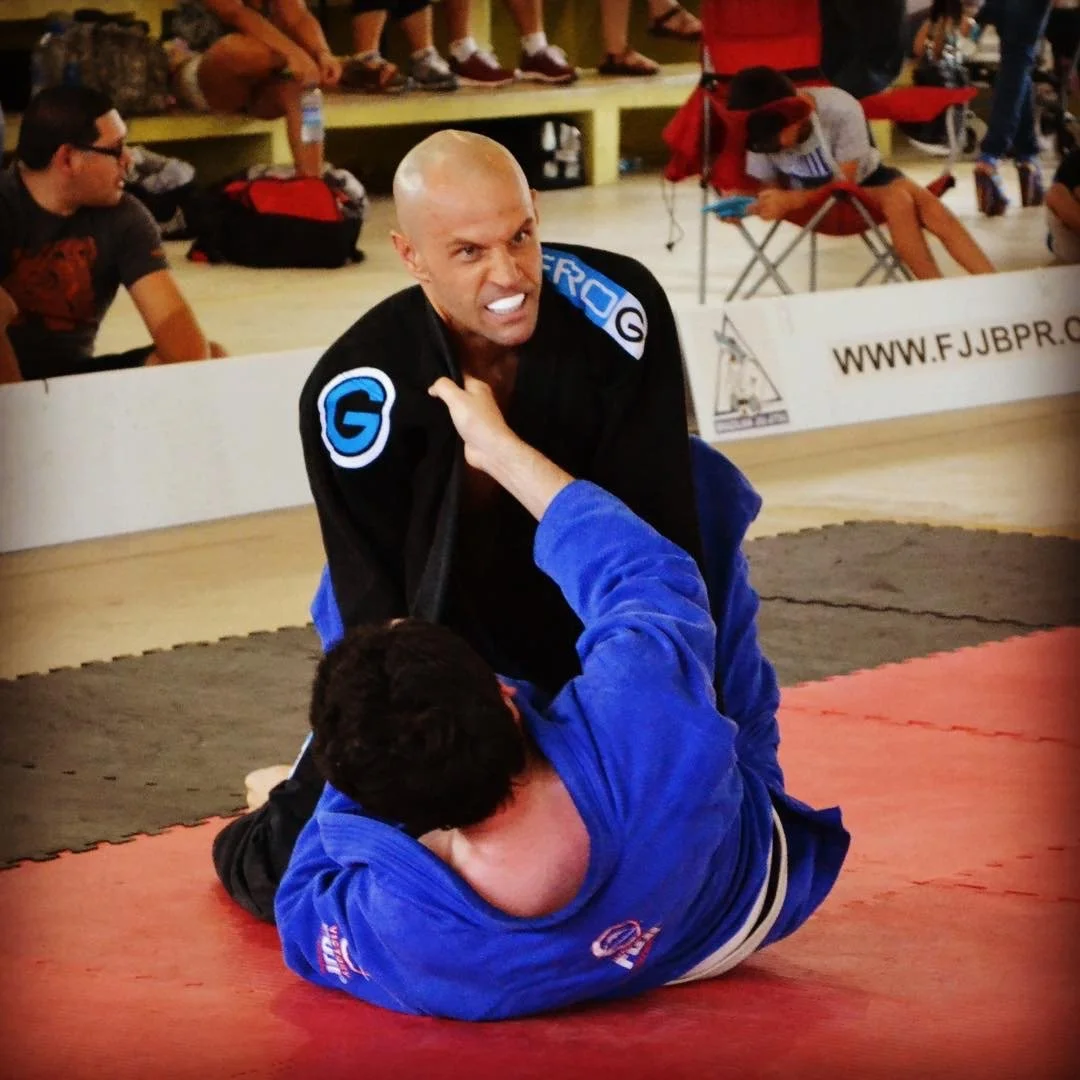
I also find my way back to martial arts and begin training Brazilian jiu-jitsu. Natalie’s ex finds me online and threatens violence if he ever sees me. I need to be ready if that time ever comes and capable of defending myself and Natalie, so I try to get as yoked as possible and learn how to grapple.
There are some people at the Air Station who train Brazilian jiu-jitsu, and I ask to train with them. It starts slowly with a couple of people, but soon a good group of us is training every day after work. I fall in love with jiu-jitsu, and I love training with my friends. What starts as a way to defend myself eventually becomes a way to cope.
There is a small room in the hangar with wrestling mats covering the floor, several punching bags, and a grappling dummy. Some days, when I am at work and I can’t focus or I am having a tough day, I change out and go to the mat room. I wrap my hands, put on gloves, and attack everything in the room. I hit those bags as hard as I can. I think of all the pain I have felt in my life, transform it into violence, and unleash until I reach exhaustion. I quickly see that every time I walk out of there, I feel better.
After the crash, no matter how much I am struggling, I still make it to the gym and train martial arts. These sessions become non-negotiable for me, and I quickly realize that, like drinking alcohol, exercise gives me distance from the pain. Unlike alcohol, I always feel better after working out, and it helps me through my darkest days. I realize that when I squat heavy weight, when someone is trying to choke me out, or when I assault a punching bag, all the pain fades away for just a moment.
These short moments save me.
Exercise helps me deal with the pain, but studying helps with the fear. All of these crashes weigh heavily on me, and the fear continually creeps in. There are a lot of things in aviation that can’t be controlled, but I know I can control how I show up to fly.
In our flight manual, there are over one hundred emergency procedures with over two hundred critical boldface actions that we are expected to know from memory. I review the entire emergency procedure section and recite all the boldface before every single flight. I am constantly reviewing aircraft systems, limitations, and normal procedures. There is some part of me that believes if I do all of these things, it will keep me safe. I need to believe that there is something that will keep me safe. I need to believe that if I “honor my profession,” nothing bad will happen to me or the people I care about, because if I don’t, the fear will win, and I won’t be able to continue flying.
I constantly think about the aircrews who have died and the pilot we pulled out of the water, and I am determined to honor them and the sacrifices they made.
I am struggling, and I am afraid, but I refuse to let the struggle define me, and I can’t let the fear overtake me. Aerodynamics taught me that any type of airfoil, whether it is a plane’s wing or a helicopter’s rotor blade, must have motion to create lift and stay in the air. Without air flowing over an airfoil, it stalls and plummets to the earth.
Right now, I am functioning the same way.
If I don’t keep moving forward with exercise, training, and studying, I will fall.