Pros and Cons
July 2023
I’m jolted awake by some type of horrific trumpet blaring over the speakers. I blink my eyes and have no idea where I am. I hear a cacophony of screaming, banging trash cans, and other noises I can’t make out. My sheets and pillow are soaked with sweat, and I think it must be a nightmare. Then I remember how I got here…my first morning of “Swab Summer.” As I climb down from my rack, we are instructed to be dressed in gym gear and on the bulkhead immediately. We are all way too late and reprimanded. “When you hear Reveille, you are to immediately get dressed and be on the bulkhead by the time the song is finished. In the Coast Guard, if you are late, people die.” Once we are on the bulkhead, we have to count off. While standing at attention, we look over our right shoulders at the person next to us. The first person screams, “Zero-one, sir!” then looks straight ahead, and we go down the line. Having been awake for less than a minute makes it impossible to execute this task. The cadre swarm us as we are counting, and any miscount or failure to sound off as loudly as possible results in us starting over and getting screamed at. Eventually, we are ushered out to the parade field for morning PT. The workout is fun and mostly bodyweight calisthenics while getting screamed at. At all times, we are getting screamed at.
After PT, we are given five minutes to shower, shave, put on our dress uniform, and be out on the bulkhead for breakfast formation. The shaving is an assault on my face. Showering is basically pointless because there is no time to dry off, and the clean water on my body immediately mixes with sweat. I put on my dress uniform, and it is stuck to my wet body. I run out to the bulkhead, tripping all over myself, well after the five-minute deadline. We count off again and are marched to the quad. In the quad, all the swabs are arranged by platoon and company, and for the minutes leading up to the formation, it is chaos. The cadre inspect our uniforms as they ask us our required indoc questions. We are required to learn an entire book of indoc, know all the movies playing at the local movie theater, and know the next three meals that will be served in the wardroom. During the formation, everyone is screaming this information at the top of their lungs. We get indoc wrong, our uniforms are wrong, everything we do is wrong. Eventually, the storm passes, and we report that each platoon and company is all present and accounted for before going to breakfast.
Meals aren’t fun. We eat family style and pass trays of food first to our cadre and then to our fellow swabs. We are taught how to sit at attention, totally erect, without touching the back of the chair and with our eyes in the boat. We stare awkwardly at the person directly across from us. Meals must be squared, meaning you attempt to grab some food with a fork, bring the fork straight up to eye level, and then make a right angle toward your mouth. About half the time, the fork is lifted into my eyeline and it’s empty. Randomly, while we are trying to eat, we are asked indoc questions. We stop eating and scream useless information. There are other random rules. If you drop food on yourself, you have to slam on the table and scream, “Boom! I have been hit. Ma’am, request permission to lay below and assess the damage.” Once the meal is winding down, someone on regimental staff announces to the wardroom, “Leave at will.” Every swab brings their watch up to eye level and notes the time. Exactly three minutes later, every swab in unison screams, “Sir, one hundred and eighty seconds have fleetingly flit into the dark ages of the past since the cadet in command gave abandon at random. May I please be excused, sir!?” After that display of nonsense, the swabs march out of the wardroom.
Every moment of the day is filled with activities. We do everything from swimming, sailing, math class, etiquette class, marching, obstacle course, and human resources training. In between activities, we get in trouble, do more PT, and get screamed at. Every single thing we do is not good enough. At least once a day, someone’s room gets totally trashed. Mattresses are flipped, and clothes are thrown everywhere. Sometimes it’s because you leave your light on when you’re not in the room. The cadre assume there must be someone in the room if the light is on, so they do a “Search and Rescue Mission,” checking the entire room by dumping the contents of your closet and drawers onto the floor. The harassment is relentless until 2200, when we finally observe “Taps” and go to sleep. The next few days are a blur and continue with the same organized chaos.
On Friday, July 4th, a certain cadre approaches me at formation for a uniform inspection.
“Swab Matthews, did you shave this morning?”
“Yes, sir.”
“You didn’t shave close enough. You need to shave again.”
“Aye aye, sir.”
I shave again.
Later, at the next formation, he says, “Swab Matthews, I told you to shave again.”
“I did, sir.”
“Swab Matthews, from now on, I need you to shave before every formation. You should have a razor with you at all times.”
“Aye aye, sir.”
A week ago, I was spending at least an hour every evening bathing and following a perfect routine to ensure my skin wouldn’t break out. I was shaving every third day with a ten-step process that had proven effective at minimizing any chance of razor burn. I was showering immediately after any amount of sweat because I feared a spontaneous breakout could happen at any moment there was sweat on my skin. I was desperately holding on to that one bit of control and still hyperfixated on my appearance. Now any bit of control I have left feels threatened as my skin is hurriedly ravaged by a razor three times a day.
That night, instead of observing Independence Day, they bring us down to lower field for some special nighttime IT. IT stands for “Incentive Training” and is essentially extra brutal physical training designed to give us more “incentive” to perform better. It is punishment, and it is designed to systematically break us down. While we are running through calisthenics and getting screamed at, the cadre point toward the Gold Star Memorial Bridge, where I-95 crosses the Thames River. “All you need to say are three letters DOR, Drop on Request, and you can go over that bridge to freedom and hang out with your friends. All your friends are enjoying the Fourth of July without you. All your girlfriends and boyfriends are out forgetting about you. All you need to do is DOR, and you can be free. You don’t have to suffer out here with us. You don’t need a life of service where you miss holidays and your friends and family. DOR will set you free.” I think about all the amazing Fourth of Julys I have had spending the day lifeguarding, spending the night with friends, and watching fireworks. The Fourth of July is my favorite holiday, and I had been looking forward to it all summer. I think about my girlfriend, my friends, and my family, and at that moment, something happens. A tiny whisper of an idea.
I could quit.
That night in Chase Hall, that whisper gets a little bit louder.
The next day, the cadre continues to harass me about shaving at every formation. After shaving three times a day, my skin is already cut, sore, and rashy.
On Sunday, he barges into my room for a surprise inspection. He gets inches from my face to critique my shaving job and proceeds to tell me it is not good enough. Then he trashes my room. The room isn’t the only thing that feels destroyed. He has dismantled the last bit of control I think I have over my life. Sitting in the mess, I stop thinking about cleaning my room or surviving the next formation. I start imagining what the future has in store for me, and I panic. Seven more weeks of Swab Summer. Seven more weeks of shaving three times a day while living in sweat and chaos. Four years at the Academy. At least five more years of service after that. For me to become a pilot, everything has to go right, and I can’t envision a future in which I make it.
The whisper from Friday builds into a scream.
I can't do this.
It is at that moment that I let myself quit.
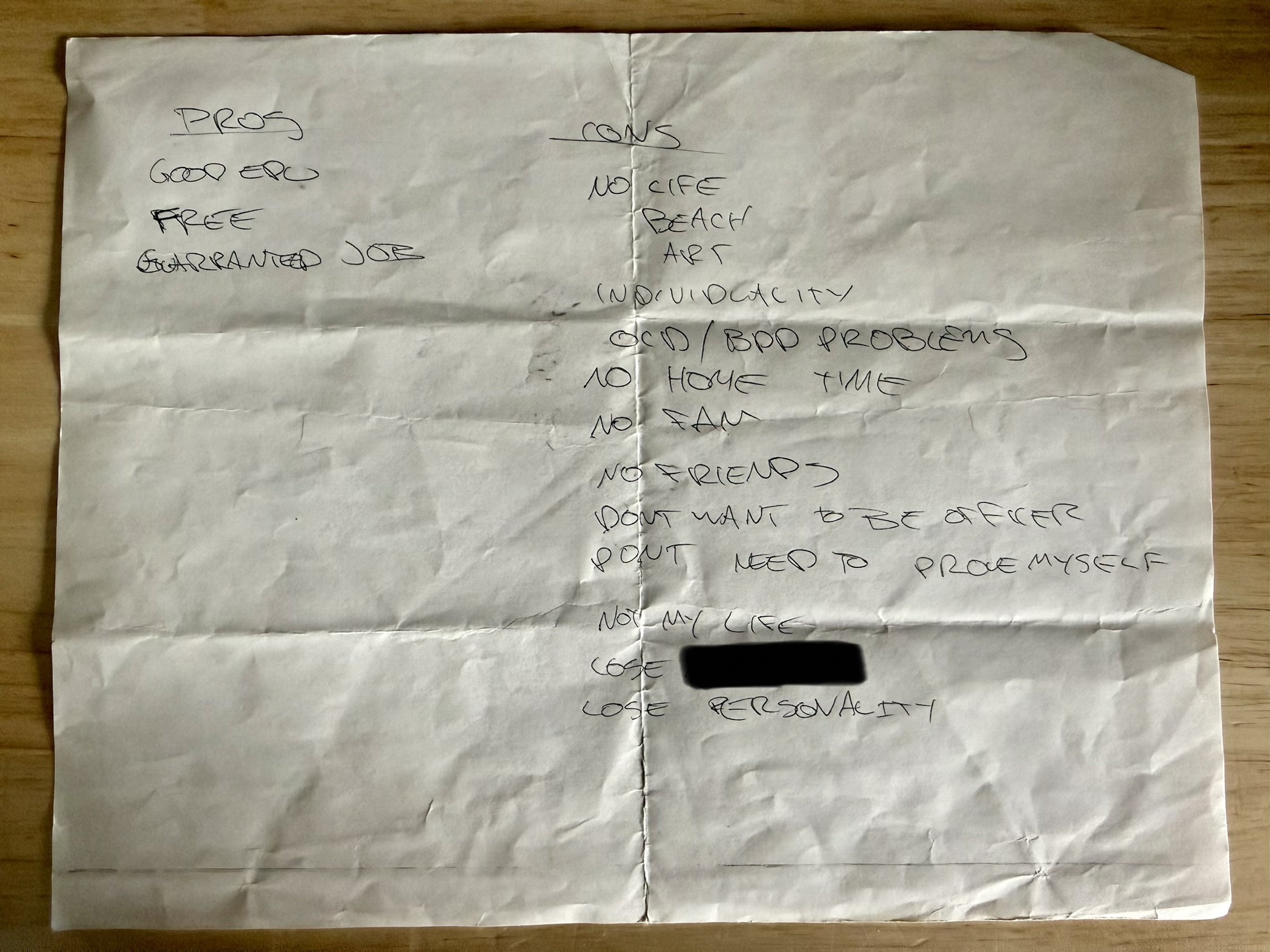
Sunday evening, they give us some time off to write letters home and prep our uniforms. My dad always encouraged me to write pros-and-cons lists whenever I had to make a big decision, so I sit down at my desk with pen and paper and write the pros and cons of staying at the Academy.
In the pros column, all I come up with is “Good edu[cation], free, and guaranteed job.” That’s all I’ve got.
Now the cons flow easily.
“No life, beach, art, individuality.”
“OCD/BDD problems.” Although I never had any diagnosis, this is the best way I could understand my situation.
“No home time, no fam, no friends.”
“Don’t want to be an officer.”
“Don’t need to prove myself.”
“Not my life.” This one doesn’t even make sense, but I am just adding lines at this point to bolster the cons section.
“Lose _____.” My high school sweetheart, whom I am obviously going to spend the rest of my life with.
“Lose personality.” More useless fodder.
Looking at this comprehensive list, it is clear what I must do now. I march out of the room and go find the one cadre who seems nice. I ask her if I can talk to her and immediately break down. I tell her I want to quit, and the repercussions are immediate. She tells me to wait where I am and gets the higher ranking Company Commander. The Company Commander is the star of the football team and everything you think of when you imagine the perfect military academy cadet. He quietly escorts me to my room and tells me to pack all of my stuff. I take my green seabag with everything I own and follow him down the passageway. We go to a different wing of Chase Hall that I have never been to, and he puts me in a room by myself. The whole hallway is dark, and there is nobody around. He tells me where he will be if I need anything and just leaves me there. I have no phone, no computer, and no contact with the outside world. I am in a room by myself and have no idea what happens next. I am alone. I am a quitter. I have no plan.
I feel strangely free.
I am free from the pressure, free from the yelling, free from the expectations, free from all of it.
The next day, I am taken to breakfast. The Company Commander escorts me down to the wardroom after the normal meal time. I eat peacefully, looking down at my food in silence. It is glorious.
Who knew being a quitter could feel so nice?
After breakfast, I am escorted to various places to go through the checkout process, and eventually I am brought to Leamy Hall to meet with the chaplain. To my surprise, it is not just the chaplain. My mom, dad, and girlfriend are there, and I immediately break down in tears.
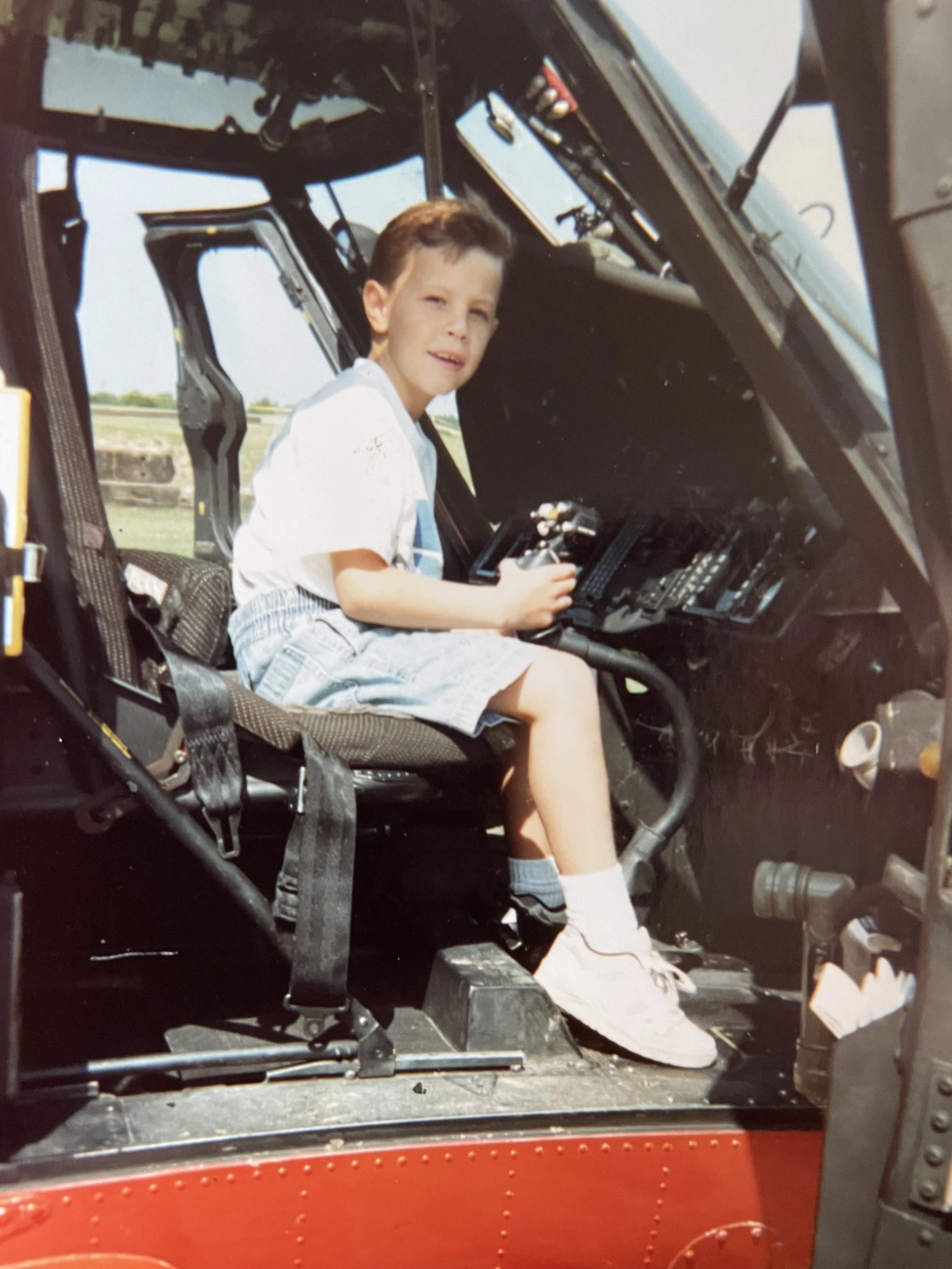
I am embarrassed. I can’t imagine how disappointed they must be, but it is immediately apparent that they are only there to support me. `My parents have brought a small toy Coast Guard Jayhawk helicopter. I’ve had it for years. Most of the paint is worn off, and the rotor blades are crooked. I used to carry it around with me to remind myself of what I was working toward. They also brought the photo of me from Coast Guard Day in 1999, when I sat in a Coast Guard helicopter for the first time. My dad tells me the story of when he quit during second-class summer. Bertie Boy dragged him back to the Academy and encouraged him to finish. He shares that he wanted to quit every day he was at the Academy, but he is forever grateful for the 28-year career that followed and the impact he was able to make. Everyone is gentle with me. They give me space to break down and a place to land. My girlfriend promises me she’s not going anywhere and will be home thinking about me every day. My parents also know my weak spot and my dad asks, “What do you think Bertie Boy and Grampy George would be telling you to do right now?”
They ask me what my plan is if I leave.
I don’t have one.
They know there has never been a backup plan, but they don’t tell me what to do. They make it very clear that if I go home with them that day, or leave at any point, they will love me and support me all the same.
They remind me who I am, a boy with a dream who always felt like he wasn’t good enough but showed up anyway and proved everyone wrong. A boy who faced hard days as a kid but was adored and supported by his family. A boy who never asked for help or support and fought his battles alone. I am overwhelmed that they show up for me anyway. They believe in me in that moment far more than I believe in myself, and it changes me forever.
I decide to become someone who will never quit.
I decide I want to stay. By some miracle, I never fully disenrolled, and the Coast Guard Academy allows me to return.
I often wish I could go back and erase the fact that I quit at all. I have always been embarrassed about this moment of weakness, but I needed to break to learn how to be strong.
Before I continue, I need to explain what I mean by quitting. I am not talking about changing direction because you discover that you genuinely want something different. I am not talking about making a smart decision when a goal no longer fits the life you want to live or no longer supports the person you want to become. That is a course correction. That is strategic.
Quitting, as I experienced it, is different and far more egregious. Quitting is abandoning something you still deeply want because the road to get there becomes more painful, frightening, or difficult than you believe you can endure.
Make no mistake, I QUIT the Coast Guard Academy, and I learned that quitting has a pattern.
One of the things we eventually learn during Swab Summer is basic damage control. Aboard a ship in the middle of the ocean, we have to be able to save the ship and ourselves. We are taught several valuable skills including how to plug a leak, how to shore a bulkhead, and how to fight a fire.
We are taught about the fire triangle, which is one of the foundations of firefighting. For a fire to exist, it needs three elements: an ignition source, a fuel source, and oxygen. If you remove any one of the three elements, the fire extinguishes. If those elements remain, the fire will burn down everything in its path.
By quitting the Academy, I learn that quitting behaves in much the same way and it has its own triangle. The quitting triangle is also made up of three elements: the whisper, the reasoning, and time projection.
The whisper — The whisper is simple. Just the tiniest thought of, I could quit. On the Fourth of July in 2003, that whisper enters my consciousness and rapidly gains strength. Before that moment, quitting is not an option. I have never seriously thought about it, but once the idea takes hold, it becomes dangerous.
The reasoning — We do not want to believe we are quitters. For many of us, it is painful to come to that realization, so we play a trick on ourselves. We convince ourselves that it is not really quitting and tell ourselves that we never wanted the thing in the first place.
This is abundantly clear in my pros-and-cons list. That list is total and absolute bullshit.
Just months before, I wrote in my Coast Guard Academy application, “This may sound melodramatic, but I am serious when I say that a career in the Coast Guard is just as important to me as my beating heart, and just as my heart has always been with me, so too, has my desire to be in the Coast Guard.”
Now the only pros I can muster for staying at the Academy are administrative nonsense. “Good education, free, guaranteed job.”
The reasoning is insidious because you will tell yourself almost anything to avoid sitting with the fact that you are quitting. That night I spend alone in quitting purgatory, I have all the speeches rehearsed about how I am going to tell my friends that I didn’t really want it and that it wasn’t what I thought it would be.
I even have a story in the chamber about how, on the second day, a fellow swab is running the mile-and-a-half entrance physical fitness exam, can’t finish, and needs to be carted off in an ambulance. I am ready to use that as evidence that the place is soft and not even a real military institution up to my standards.
That night, I only feel free because I have worked so hard to convince myself that I never wanted to be at the Coast Guard Academy.
Time projection — The reason I loved the week of AIM and quit during the first week of Swab Summer is time projection. I face many of the same issues with my appearance, compulsive behavior, and loss of control during AIM, but I know it will be over in a week. I never once doubt that I will make it through.
The day my room is destroyed, my time horizon suddenly expands to seven more weeks of Swab Summer, four more years at the Academy, and then a minimum five-year service commitment. I am staring down the barrel of what feels like a neverending sufferfest, and I know I cannot make it that long. We allow ourselves to quit when the amount of time required to accomplish something exceeds what we believe we are capable of enduring.
The good news is that, like the fire triangle, we only need to remove one element and the quitting extinguishes.
Silencing the whisper — The best way to silence the whisper is to fully believe that you are someone who does not quit. If a no-quit mentality is a core part of who you are, that whisper won’t dare raise its voice.
Interrupting the reasoning — To avoid falling victim to the reasoning, you need to remember your why. When I quit, I ignored my why. I buried it beneath layers of nonsense, and it was nearly catastrophic. When my family shows up at the Academy that day, they remind me that I have spent my entire life dreaming about the opportunity I am about to throw away.
Shortening the time horizon — After I return to the platoon, the cadre I initially approached about quitting pulls me aside. She asks how I am doing, and I can tell she genuinely cares. She tells me that she thought about quitting every day of Swab Summer and for most of her fourth-class year. She explains that her mantra during Swab Summer was to make it to the next meal without quitting. She always knew she could survive the next few hours, so she focused only on that next meal. Once she proved she could make it to lunch, she set her sights on dinner. Then she repeated the process over and over until she made it through.
After this moment at the Academy, I go on to do many hard things, and I do not quit. None of it is because I am anything special. I just learn to put out the fire before it burns down everything in its path.
When the whisper starts, I remember the pain of quitting and what it almost cost me. I remember who I am. I don’t quit and quitting is no longer an option.
I remember my why, and I do not let myself reason my way toward the easier path.
I don’t look too far downrange. I focus on the next step.
I just make it to the next meal.