The 10% Chance
August 2014
A month after our small beach wedding, it’s time to deploy again. I’m not looking forward to being away, but I’m happy because I am going with one of my best friends, Kenny Ingram. Kenny and I were in flight school and at Air Station Borinquen together. I have always admired Kenny because he is extremely kind and an eternal optimist with a contagious positive attitude. Kenny is fun to be around and is the type of person I want to be. He is also an incredible pilot. Kenny and I do all our deployment preps together and are ready for our long adventure.
Saying goodbye to Natalie doesn’t get any easier. I can see how heartbroken and worried she is every time I go, and leaving her feels terrible. At least when I leave this time, we are married, and she is officially part of a big Coast Guard family that can take care of her. There is a small bit of consolation in knowing that.
The boat we are deploying on is notoriously awful. The executive officer, XO, is reportedly a tyrant, and the morale of the crew is abysmal. The current crew on board has also never had a drug interdiction, despite several lengthy deployments. It’s not ideal.
One of the first things we do on the boat is conduct an in brief. It is a nerve racking first impression for the aviation detachment, AVDET, as we stand in front of the command and most of the ship’s crew. We brief on the capabilities we bring as a HITRON asset and review mission planning. Kenny leads everything and is giving a professional and poised brief.
The final part of the brief is to go over some joint exercises we have planned for the next day with the boarding teams. We are going to run an entire simulated interdiction to ensure we are a cohesive force. Kenny briefs that the final stage of the exercise is to simulate our helicopter crashing on the flight deck to exercise the mishap response.
The XO stands up and throws his notebook on the ground.
“What the f__k, Kenny?! That was supposed to be a surprise, and now everyone knows there’s going to be a crash on deck drill.”
Kenny stands there flummoxed and apologizes to try to ease the tension.
The Commanding Officer, who has just reported and taken command within the last week, also looks confused and begins speaking to try to get the brief back on track. I am a deer in headlights as I look between the XO, Kenny, and the CO.
This is going to be a long couple of months.
There is always some tension between the personnel on Coast Guard cutters and the aviation detachments. The communities are very different, and we are merely guests on their boats. Aviators tend to be more relaxed about military customs and courtesies, and the surface fleet is rigid and traditional. We also have strict crew rest standards and regulations about sleep, which tend to disgust the surface fleet, since they often stand double watches with minimal sleep. Every ship is different and has different policies, so we have to learn to blend in and respect the things that are important to them to create cohesiveness around the mission. This usually isn’t a problem, and we often fully integrate with the cutter crews.
On this boat, it is a problem.
It doesn’t take long for the XO to let us know the aviators are in his crosshairs. On one of the first days underway, he finds one of our aircrew working out on the flight deck. These ships are small and don’t have dedicated gyms, so often there are rusty free weights on the fantail or flight deck. As our aircrew is wearing headphones and trying to enjoy a nice set of bench press, he sits up and finds the XO within inches of his face. The XO motions for him to remove his headphones and then proceeds to berate him about how he should never be wearing headphones aboard ship. Then he critiques the manner in which he put the weights down. Despite the flight deck being able to support a 9,000 pound helicopter landing in a controlled crash, the XO is convinced that putting the dumbbells down too hard will destroy our landing area. He threatens to send the whole AVDET home to explain to our command why we wrecked his ship.
Kenny finds out about the mistreatment of our crew and meets with the Commanding Officer. The CO is a great officer and strong leader, but he hasn’t been on the boat long enough to affect change. He uses this opportunity to try to course correct the XO, but things don’t get much better for us.
Meals are tense as we are all forced to eat in the wardroom with the other officers. It’s not uncommon for the XO to pop off on someone at the table or storm out of the wardroom to yell at someone in the galley. There is mostly nervous small talk from the young junior officers, who seem terrified and dread every meal.
Luckily, we get a brief vacation from the ship whenever we go and fly. Kenny, our gunner, and I get to debrief all of the absurdities of the ship in a safe environment in the sky, miles away from the cutter. It’s a welcome reprieve.
Every day feels the same, and we tick down days of deployment without getting a single piece of actionable intelligence. The morale of the entire ship’s crew is continuously plummeting.
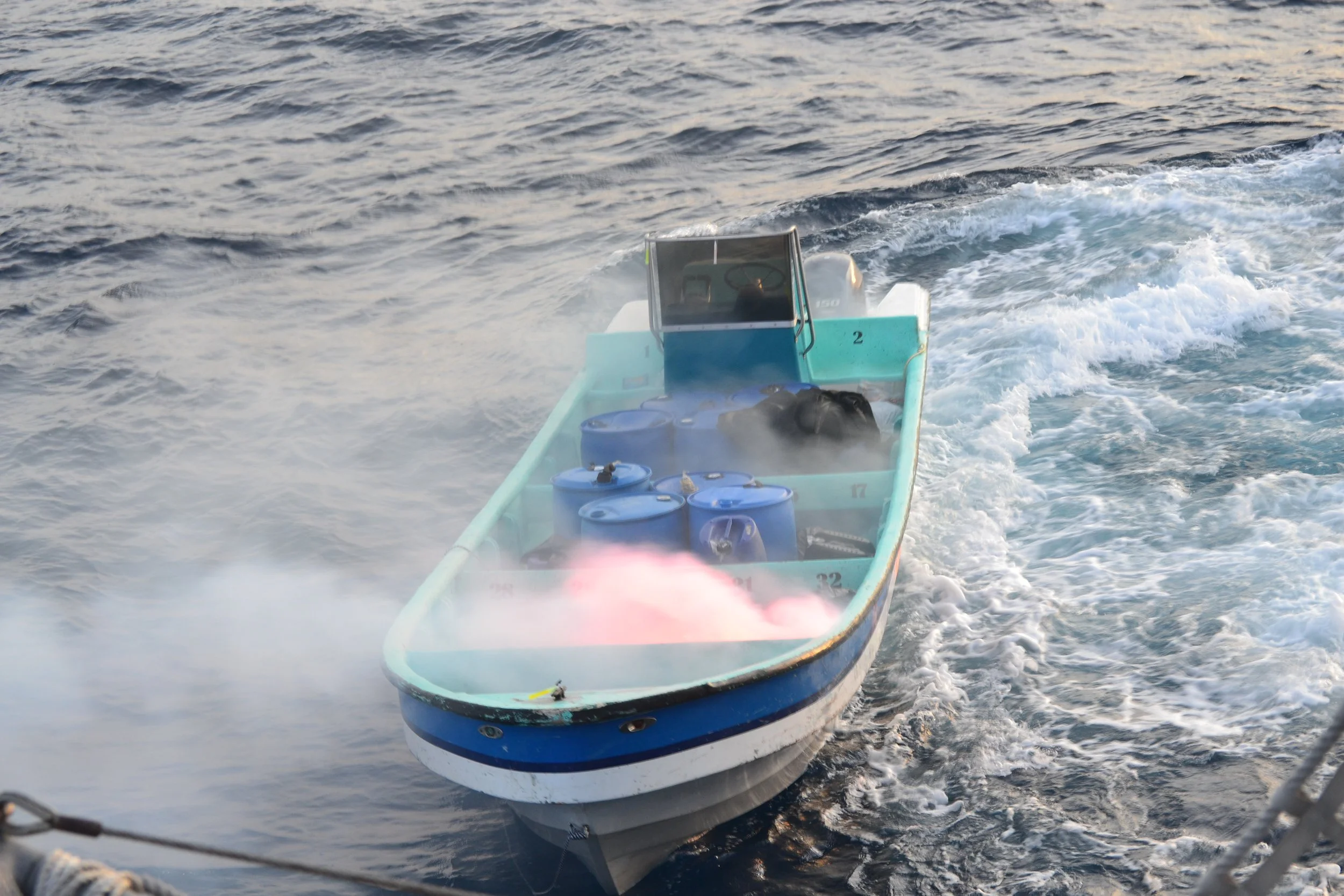
Then it finally happens. Several weeks into the deployment, the alarm sounds just after 2300, and the ship sets the go-fast bill. On this ship, which has been on several deployments and never made it to an interdiction, the excitement is palpable, but there is a lot of nervous energy. Nobody on the boat has done this before except us.
All I can feel is the entire crew looking at us, hoping we interdict this vessel and get them a win they so desperately need. I feel a tremendous amount of pressure to execute. After the brief, we gear up and head to the helicopter.
It is a terrible night to fly. There is no moon, and there are scattered storms and low overcast skies throughout the area. It is dark, hazy, and scary, but we have to go. We launch into the darkness and head about 40 miles from the boat to find the go-fast. There is a plane circling overhead and tracking the go-fast, giving us constant position updates.
We arrive at the go-fast’s position just after midnight and make an approach toward the water. With no moon, no starlight, and no ambient light whatsoever, our night vision goggles are basically useless. At 75 feet, I can barely make out the surface of the water, and the airplane overhead gives us vectors to the go-fast. We fly directly over it at 75 feet and never see it.
I quickly realize that these conditions are going to make this interdiction impossible and dangerous. We climb up slightly and make another orbit around the go-fast, attempting to acquire it visually with vectors from above. It takes several passes for us to find the boat, nearly invisible in the darkness just beneath us. Once we have it in sight, we begin our process of disabling it, and the go-fast proves to be highly skilled at evading us. Every time we are almost in position to fire a shot, they maneuver erratically and again disappear into the darkness. Part of me knows how dangerous this game is and that I should just return to the ship, but all I can think of is seeing the entire crew disappointed. I can’t do that to them, so I keep fighting.
We continue to maneuver aggressively at 75 feet in total darkness, continually losing and reacquiring the go-fast for nearly an hour. We manage to get some shots off and are close to disabling the go-fast when we get a “bingo” annunciation. We are at our minimum fuel level to return to the ship with a comfortable amount of reserve fuel. We discuss as a crew lowering our fuel reserves and the risks associated with it. We acknowledge the bad weather in the area, but we are so close to completing this interdiction and getting the ship some good news. We confirm the position of the ship with several different methods so we know exactly where our floating gas station is. We tell the ship that we are lowering our fuel reserves and that they need to be ready for us to land in a hurry.
We reengage the go-fast and continue to battle in the darkness. Not long after, we get the bingo annunciation again, and it is time to go. We transition up to altitude, secure our weapons, and configure the helicopter for landing. We set up on final for the cutter and perform an approach to the water. Just after 0100, I establish the helicopter behind the boat at 100 feet over the water and 45 knots and get a terrible sinking feeling.
I can’t see anything.
I can’t see the water. I can’t see the boat. I can’t see a horizon. Only darkness.
“Hey, Kenny, I can’t see the boat or the water. I’m going to pass you the controls. Do you have the boat in sight?”
“Nope. You can stay on controls.”
I am coupled up on the flight director modes, basically autopilot that will maintain our altitude and airspeed. I feel like the flight director modes are cramping my style. I ask Kenny to take me off the modes so I can fly manually. He refuses and keeps me coupled to the flight director. At this point, it is taking every bit of my concentration to trust my instruments and keep the aircraft upright. I still have no visual references, and the boat is not there. We think we have it figured out, and Kenny calls the cutter.
“Request you energize your lighting.”
Clearly, they forgot to turn their lights on.
“Be advised, we are at 100 percent NVG lighting.”
“Roger. Please pass an updated position.”
Kenny receives their position and programs it into our computer. It shows the boat directly in front of us, 0.3 nautical miles away. They are just over 500 meters away, but somehow, we cannot see a trace of the 200 foot cutter. I slow down slightly as we try to figure this out, but I notice both fuel gauges are in the yellow. We are rapidly running out of gas. I know that if I can’t land this helicopter on the ship in a hurry, we will be ditching somewhere in the middle of the ocean in complete darkness.
I find myself thinking about Natalie again. I think of her at home planning our big wedding and how devastated she’d be if I crashed out here. I need to land on the boat. I descend to 60 feet over the water, hoping that it will somehow help, and I still cannot make out the surface of the water or a horizon. I change to a different flight director mode that allows me to maneuver but holds my altitude at 60 feet. I know the boat is underway on a recovery course and sailing away from us, so I decide I need to move forward. I push the cyclic toward where I think the boat is. I keep pushing until I see my ground speed vector move and I am sure I am accelerating. At 0.2 nautical miles, just under 400 meters, I see a faint glow where the boat should be. I can’t make out any part of the ship, but I am relieved to see something there.
The next problem is that this faint glow is moving in every direction. With five foot seas, the cutter is violently pitching, rolling, and heaving, and with no other reference to follow, I am attempting to point at it and flying erratically. I am death gripping the cyclic and doing everything I can to keep the glow in the center of the windscreen. My movement, coupled with the ship’s movement, makes the glow impossible to track, and it is incredibly disorienting. I want to slow down and reduce my closure rate with the boat because, at 60 feet over the water, I am afraid I’ll run right into the boat, which is nearly 100 feet tall. I look at the fuel gauges, and they are dangerously low. I am running out of time. There is no slowing down.
I keep moving forward.
All of a sudden, the boat appears, and we are nearly right on top of it, screaming toward the superstructure. I immediately disengage the flight director, drop the power, and pull back hard on the cyclic to bleed off all our airspeed. We slow down, and I rock the nose forward, sight the flight deck, and land poorly with barely any gas left.
Then, as I look up at the overhead floodlights illuminating the flight deck, everything makes sense. We are in a rain squall, some of the hardest rain I have ever seen, and it is coming down in sheets. We knew it was dark out. We never realized it was so dark that we were flying through a wall of rain and couldn’t tell.
The cutter tries to hot refuel us and launch us again into the dark abyss. We refuse and shut down. The Landing Signal Officer on the flight deck tells us that he couldn’t see us until we were over the fantail. Visibility is less than 100 feet.
Kenny is rightfully upset and runs up to the bridge to try to figure out how the boat drove into a wall of water and failed to tell us. It turns out that when we informed them we were lowering bingo, they immediately established a recovery course, which took them directly into the squall. While Kenny is in a heated discussion on the bridge, another nearby cutter launches their HITRON helicopter. This other crew arrives on scene, determines the conditions are not safe for an interdiction, and returns safely to their cutter.
Despite how terrifying the last flight was, I want to go back out. We are in a fight with this go-fast, and the whole cutter is watching. I can’t let the crew down. I can’t let the go-fast beat me.
Kenny comes back from the bridge, and we have a discussion about risk. We all admit that we scared ourselves, but we are ready to go back out. Our precision marksman tells us that he gave us a 90 percent chance of ending up in the water, and on our way back in, he was going through his ditching procedures. It was terrifying, but we all feel like we have to finish what we started.
Now, just after 0300, we strap back into the aircraft, start up, and launch into the dark abyss. I completely block out the last flight and think only about accomplishing the mission. As we head toward the last known position of the go-fast, we get a surprising radio call. The cutter informs us that their small boat was able to catch the go-fast and perform the interdiction. We turn back toward the cutter and land just after 0400, exhausted.
When I wake up the next morning and the adrenaline has worn off, I can finally think clearly about the night before.
I have spent so much of my life building my identity around being someone who never quits and keeps moving forward no matter what. That attitude got me through my childhood, rejection, the Academy, and flight school. Even last night, moving forward saved me. If I had maintained my position with the boat driving away from us, we would have ditched in the dark, unforgiving ocean. Instead, I moved forward into the dark, toward the unknown, and we landed on the boat without a moment to spare.
I can also see that the same attitude, the same refusal to quit, put our crew in danger.
I should have admitted to myself that the conditions were not safe to execute the interdiction and returned to the ship. I should not have continued to fight with the drug smuggling vessel or lowered bingo. I definitely should not have taken off again at three in the morning after having a significant emotional event. I put so much pressure on myself and felt like I would disappoint the crew, so I let my ego get the best of me.
I am proud that our crew made it back safely and slowed the drug smuggling vessel enough for the small boat to catch it. We helped get the cutter its first ever drug bust, which they desperately needed. I am not proud of accepting unnecessary risk.
Afterward, when we talked to our Commanding Officer, he said, “This happens to all operators at one point or another. You go in bold and come out wiser.”
I often reflect back on that night. I think about the invisible wall of rain, our fuel gauges begging us to land, the cutter hiding in plain sight, and the gunner behind us preparing to ditch. I think about him giving us a 90 percent chance of crashing into the water.
Throughout my life, I had learned to chase the 10 percent chance. I had built an identity around being the person who kept fighting when the odds were terrible.
That night, I learned a different lesson.
I learned that courage is not always moving forward. There are times when courage is walking away. There are times when courage is disappointing everyone but ensuring the crew can stay alive. Sometimes courage is saying no to the mission.
I went in bold.
I came out wiser.