Cindy and the Footprint
June 20th, 2017
It's just after 2200 on June 20, 2017, and we are headed into total darkness. A 68 foot fishing vessel is rapidly taking on water and sinking on the fringes of Tropical Storm Cindy, 100 miles offshore.
As we cross the shoreline out over the Gulf, it is uncomfortably dark. There is no moon, the skies are cloudy with occasional bands of driving rain, and the winds are blowing over 40 knots.
It is a nightmare.
The transit is about an hour, and we are headed toward the tropical storm with the weather constantly deteriorating. We are lucky enough to have a fixed wing C-144 CASA from Air Station Corpus Christi overhead to provide cover so at least we are not alone.
The CASA is flying up high and able to establish communications with the sinking vessel as we rush toward them. The vessel is named “Footprint,” and it's a shrimp trawler with four crew members on board and water rushing into the engine compartment. The CASA provides us with updated positions as the vessel attempts to limp toward shore.
Just before 2300, we spot the lights of the Footprint and brief our approach to the boat. As soon as we begin our descent, the collective channel of our Automatic Flight Control System (AFCS) fails. A few moments later, we also lose the yaw channel.
The AFCS works constantly in the background, making small corrections to the flight controls to help keep the helicopter steady. Losing two channels makes the helicopter more demanding to fly. It also means we can no longer use the autopilot functions we need for the approach and to assist us with hovering. We'll have to make those corrections ourselves and fly everything manually.
This is challenging on a beautiful, sunny day. In the middle of the night, during a tropical storm with 40 knot winds, this is a worst case scenario. We discuss the risks and determine that without these channels, the danger has increased significantly, but once we see the boat, we know we have to help them.
The Footprint is riding extremely low in the water because of all the flooding inside and is pitching and rolling violently in the high seas. It's clear that she might sink soon, so we perform the difficult approach to the water and get into position to hoist.
Our plan is to deploy the rescue swimmer and a dewatering pump. The swimmer can help guide the pump onto the deck and also be there in case the vessel sinks and he needs to keep the survivors afloat.
The trawler has rigging and lines everywhere on the deck, making it a terrible platform to hoist to. Additionally, they are running toward shore, which puts them downwind and downswell. This is the exact opposite direction we need them to head for us to hoist down our rescue swimmer.
None of us in the helicopter are boat drivers, but we all agree that if the boat turns around into the wind, the seas could come over the freeboard and potentially sink it as it turns broadside to the swells. We have to attempt an impossible hoist.
I am in the left seat as the pilot in command, responsible for the overall mission. Zach Gross is my copilot, and he is extremely smart and a phenomenal pilot. At this point, we have about 40 minutes of on scene time before we need to head back to Galveston for fuel.
We make our approach to the water and set up with the boat. Whenever we hover, we want to point into the wind because it makes us the most stable and requires the least amount of power. With our current 40 knot winds, being out of the wind line would be very unstable.
As we're pointing into the wind and the vessel is running downwind and downswell, Zach has to stay in position with the bow of the shrimp boat, which is pitching violently in the swells, while flying backward with half his AFCS channels missing. This is the hardest hoist I have ever seen anyone attempt.
We perform our final hoist briefs and check our rescue swimmer before deploying him to the shrimp boat. Zach is holding a remarkably strong position despite what he's up against, and as the swimmer is going down to the bow, it seems like it might just work out.
Once the swimmer is nearly on deck, the vessel is hit by several large swells, and the bow pitches up and out of the water. The boat's movement, coupled with the helicopter needing to stay in position while the swimmer combats a mix of rotor wash and tropical storm winds, causes a slight swing to develop, and the rescue swimmer impacts the superstructure of the shrimp boat.
I call to abort the hoist, and we recover our rescue swimmer.
Luckily, he is able to fend off the superstructure and has no injuries, but we all determine it's not safe for him to go back down, and we ready the pump for deployment.
A few moments later, after another quick hoist brief, we attempt to deploy the pump. The pump is in a large, rectangular, waterproof plastic container that has attachments for the hoist hook.
With the pump's large sail area, the wind is pushing it aft behind us, making it impossible to get it onto the bow of the ship without bringing the helicopter dangerously close to the rigging and superstructure of the boat.
We abort the hoist again.
Our only option is to see if the boat can turn around into the wind so we can deploy the pump to the stern. I talk to the captain on the radio, and he assures me that he can time the swells and make the 180 degree turn into the wind.
We back off from the boat and climb slightly while maintaining our hover.
I look at our “bingo” fuel calculation and realize we now have only about five minutes before we need to start heading back to Galveston. I know completing this hoist in five minutes is impossible, so I am going to be committed to landing on an oil rig.
There are many offshore drilling platforms in the Gulf that have helipads and fuel to support supply helicopters. The only problem is that sometimes they move, shut down, or don't have fuel. I can't risk that, and I don't have the bandwidth to figure it out, so I call the CASA overhead for help.
They get to work.
Now I am nervously watching the shrimp trawler make its 180 degree turn into the wind. The first little bit is looking good. There is a break in the swells, and they seem to be cutting through the waves pretty well. Then, as they approach the midpoint of their turn and are broadside to the swells, they take a couple of waves.
Our crew has been silent, awaiting the critical moment, and now we are all inadvertently uttering words of encouragement over the ICS.
“Come on, come on! Let's go!”
Then they take a good swell, and we all collectively groan as the vessel slowly rolls toward us.
It keeps rolling and doesn't look like it's going to stop. The superstructure is pointing at us and continuing down toward the water. There are now only a couple of inches of freeboard separating the angry, dark ocean from the deck of the ship. I am already thinking about how we are going to hoist the four survivors after watching this boat sink.
Then the rolling slowly comes to a stop, and the vessel begins rolling the other way.
We all let out a bit of a cheer as it survives that roll, but they aren't through yet. They take a couple more waves and roll some more, but then steady up into the wind. They make the turn, but there is no time to celebrate because they are still rapidly taking on water, and we are running out of time to deliver this pump, their only hope of staying afloat.
The CASA radios back that they have coordinated an oil rig. Not only have they confirmed that the rig has fuel, but they have flown over it to make sure the position is accurate and checked the weather.
I plug the position in and find that we are about five minutes from bingo fuel to the rig. Five minutes to deliver a pump is reasonable when things are going well, but with a degraded aircraft, a shrimp trawler, and tropical storm winds, it is going to be very tight.
We discuss lowering our bingo fuel reserves since the CASA has confirmed that the rig is in a good position and decide that's a good option to give us more on scene time if we need it. We brief the boat over the radio and get into position off their stern.
We elect to use a trail line, a 105-foot braided nylon rope with a weight bag on one end and a D-ring on the other. We attach the D-ring to the hoist hook. The purpose is to swing the nylon rope to someone on the boat, who is instructed to pull on it as hard as they can. Once the personnel on deck get the line taut, we start lowering the pump. The trail line stabilizes it through the rigging and prevents it from swinging as the vessel and helicopter maneuver erratically in the rough seas.
The trail line also has a safety feature called a weak link. If the line gets tangled or comes under excessive tension, the weak link breaks away from the helicopter. We don't want to be physically connected to a pitching fishing vessel.
Zach initiates by saying, “Rescue check part two for a trail line deployment of the pump to the fishing vessel.”
The flight mechanic immediately replies, “Rescue check part two complete. Ready aft for a trail line deployment of the pump. Vessel is at your two o'clock.”
“Target in sight. Conn me in.”
The flight mechanic calmly conns Zach into position.
“Forward and right 30. Forward and right 20. Forward and right 10.”
Then he keeps repeating, “Forward and right 10. Forward and right 10. Forward and right 10. The trail line is sailing aft.”
At this point, the trail line is sailing behind the vessel where they can't grab it, but Zach can't go forward much farther because of the superstructure. The flight mechanic keeps conning, and eventually Zach finds a way to get far enough forward that the trail line lands on the fishing vessel. Their crew grabs it and starts pulling on the line.
Zach establishes a position just off their stern, and the pump starts going down.
“Hold position. Pump's going down. Pump is halfway down. Position and altitude look good.”
I watch as a big swell approaches the boat. The fishing vessel slows as it climbs the swell and then rapidly pitches forward and accelerates downswell.
The flight mechanic utters an expletive, and I hear a series of grunts and groans from the back. My adrenaline surges because I know there's a problem. I look back into the cabin and see the cable swinging as the flight mechanic desperately tries to control it.
“The trail line parted! Abort the hoist!”
As the vessel came down the swell, it shockloaded the trail line and separated the weak link. Luckily, we have one more trail line in the helicopter.
During this hoist evolution, we reach our bingo fuel point, the point at which we need to leave to land with a comfortable fuel reserve. Now we have another tough decision to make. We can leave now and refuel, landing with some extra gas in case anything happens, but hoping the vessel doesn't sink while we're gone. We could also decide as a crew to lower bingo and land on the rig in a tropical storm with the absolute minimum required fuel reserve. This would provide us with another ten or fifteen minutes on scene, but we would have little room for error when it's time to land on the pad.
I ask the crew, “How does everyone feel about lowering bingo?”
Everyone agrees that this boat doesn't have long before it sinks and likely won't stay afloat while we refuel. We decide the extra risk is worth giving them a better shot at survival, so we establish a new bingo fuel point using the minimum required reserve and proceed.
Zach gives another hoist brief, and we discuss our options, including an alternate method called an indirect delivery. In this method, the vessel would stop in the water, and we would lower a trail line and drop the pump into the ocean. The crew on the boat would then haul the pump through the water using the trail line. This requires the trail line to be connected with the weak link positioned near the weight bag so it won't separate while the crew pulls the pump through the heavy seas.
Zach and I decide against it because it doesn't seem safe. If the Footprint stops moving in these seas, she could end up broadside to the swells and sink. We agree to attempt another delivery with the trail line to the stern instead.
During the discussion, I am talking to the CASA overhead and rechecking my bingo calculations and flight plan.
There is a lot going on.
Zach finishes the brief and directs the flight mechanic to start conning him in.
“Forward and right 30. Forward and right 20. Forward and right 10. Forward and right 10. Forward and right 10. Forward and right 10. The trail line is sailing aft.”
Zach tells the flight mechanic that if he comes any farther forward, he will be “lost target,” meaning he will no longer have the shrimp vessel in sight.
This can be extremely dangerous because we are already close to obstacles on the shrimp boat that Zach won't be able to see. He also won't be able to maintain his position relative to a vessel that's behind him.
For several minutes, they attempt to get the trail line onto the deck as I watch our precious fuel burn. We are only three minutes from bingo. I let the crew know that we are running out of time.
Zach makes a bold drive forward, and the trail line lands on the deck.
“Trail line on deck. Hold position. Vessel tending trail line. Vessel tending trail line. Position and altitude look good.”
Then, just as the flight mechanic is preparing to send the pump down, he mentions having the Footprint come dead in the water for the indirect delivery.
I confess, “Sorry, I think I might have confused you in the brief. We have to keep them underway, or they might sink. Let's proceed with them underway.”
“Roger, but the trail line is attached incorrectly for the deployment. The weak link is down by the weight bag.”
This isn't ideal. We have no weak link protection during this deployment and are operating outside procedure. I look inside and see two minutes until bingo.
I have to make a decision quickly. I determine that we can manage the additional risk and decide it's worth the chance to save the vessel. I can't bear to leave them sinking out here while we go and refuel.
“That one's on me. We don't have time to fix it. Consider us committed to the hoist, and if you're comfortable with it, you can send the pump down. We've only got time for one shot at this.”
“Roger, sir. I'm good with it. Pump's going down. Pump's halfway down. Position and altitude look good.”
One minute to bingo.
“Position and altitude look good. Pump is holding halfway down. They aren't pulling hard enough on the trail line. Sir, come forward and right 10. Forward and right five. Easy forward and right. Hold position. Pump is going down. Pump is on deck.”
Just as we hit bingo.
“Crew is tending to pump. Pump is disconnected. Clear to come easy back and right. Vessel is at your two o'clock.”
We did it!
We got the pump on deck. We let out a collective sigh of relief, but there is still a lot of work to do. We don't know if the crew will be able to get the pump to work, and we still have to find and land on an oil rig.
As the crew rapidly configures the cabin, I make calls to the CASA, letting them know that we will be departing the scene for the oil rig. They let us know they still have plenty of time on scene and will be able to provide cover for us and keep an eye on the fishing vessel.
We climb to altitude and head toward the rig. Once we level off, I update the flight plan and check our fuel. We should be landing with just over 200 pounds of fuel, our minimum required reserve.
We didn't have a moment to spare.
A few minutes later, we see some lights in the dark abyss and land on a small pad that appears to be floating in the darkness.
After shutting the helicopter down, I attempt to open my copilot door. The handle rotates, and it unlatches, but I am struggling to get it open. It feels like it's jammed. I heave my shoulder into it a couple of times before realizing the door is working fine. I am just pushing into 40 knots of wind.
I manage to pry it open enough to squeeze through the opening. Now I step out onto the large pad just after midnight. It's roughly fifty feet square and nearly 100 feet above the dark, windswept waters. The entire rig is shaking and creaking under the pressure of the approaching tropical storm.
There are small deck edge lights pointing down at the flight deck, and beyond that, there is nothing but darkness. There is no railing, and as soon as the wind hits my body, I stumble and struggle to maintain my balance.
I am now terrified that I will be blown right off the side of this oil rig. I would love to stay safely strapped into the helicopter, but I can't. I have to go down below the platform to pay for the fuel, and I need to use their phone to call back to OPS. Zach and I leave our flight mechanic and rescue swimmer with the helicopter to fuel and complete their required inspections.
I decide my best chance of surviving the trek across this pad is to get down on all fours and bear crawl to the edge of the platform where the ladder well is.
I slowly and deliberately place every hand and foot, trying to stay as low to the deck as possible.
At the very edge of the rig is the ladderwell. There is no railing at the top, so I reverse my bear crawl and back down into the stairwell, carefully lowering my feet onto the steps until I can finally grasp a railing.
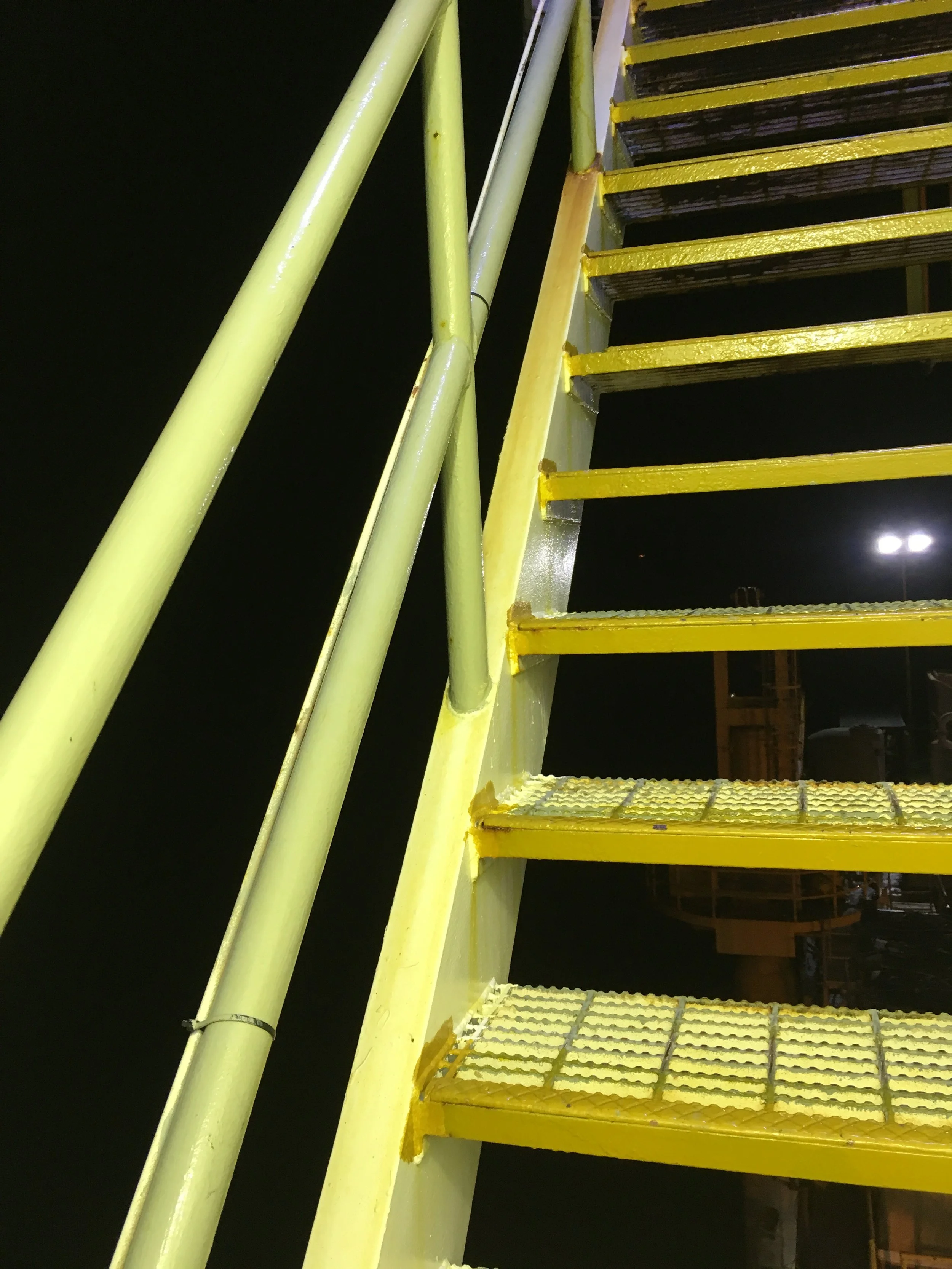
The stairs on oil rigs are generally terrifying. This one is made of metal grating, and you can see directly through the rusted metal, 100 feet down to the churning water.
I am hating every minute of this.
Eventually, I make it down the horrific stairs and inside the oil rig. It feels like we've found some strange portal into another world as we leave the wet, windy, terrifying darkness and suddenly step into the fluorescent light of a lounge area.
It looks like any other office break room, with couches, some computer workstations, and a kitchenette. One of the oil rig workers meets us, offers us water, coffee, and snacks, and tells us to make ourselves at home.
I ask to borrow their phone and call CDR Sanborn to let him know we are on deck.
He picks up right away, and I tell him it's been a crazy night so far, but we are safe and I'll debrief him on everything in the morning after we get back.
He tells me he just got off the phone with Sector and that the Footprint's crew got the pump working and is keeping up with the flooding.
Our pump saved them.
I don't have time to process that because my flight mechanic rushes in and says, “Sir, we have a problem.”
I tell CDR Sanborn I'll call him right back.
My flight mechanic explains to Zach and me, “One of the rubber hoses attached to the engine came loose. That's not a big deal, but the metal clamp that holds it in place is missing. I searched the engine compartment, but I can't find it anywhere, and I can't safely get up on the head to look.”
This is indeed a big problem.
FOD, or foreign object debris, is a serious threat to an aircraft. A loose metal hose clamp could be sucked into the engine or become lodged in moving components, potentially causing a catastrophic failure. When FOD is suspected, the aircraft is grounded until the debris is found or the aircraft is thoroughly inspected.
Unfortunately, we don't have the luxury of staying on the rig and waiting for an inspection. The stronger bands of Tropical Storm Cindy are rapidly approaching, bringing even stronger winds and more severe weather. We have no way to tie down the helicopter, and we are concerned it could blow off the rig or sustain significant damage in the storm.
We need to somehow get off the rig.
We talk as a crew and devise a plan before calling CDR Sanborn back. We discuss how there is a good possibility that the hose clamp has departed the engine compartment and is no longer an issue. We just have no way of verifying that, so we assume the hose clamp is still in there and assess the threat.
The engine intake is shrouded inside the compartment where the hose clamp is missing, so we believe ingestion into the engine is unlikely. There is a small chance it could get lodged somewhere important and cause damage, but luckily, the H-65 has two engines and redundant systems.
We assess the worst case scenario as losing an engine. If we can establish around 20-30 knots of relative wind, we would be able to continue flying on one engine. With 40 knot winds, losing an engine would be frightening, but we believe we can reduce the danger by getting away from the platform and building airspeed quickly. We can pick up into a hover over the pad, dive off the side of the rig, and establish the airspeed we need as quickly as possible.
It's not the best plan, but it's the only option we can come up with.
I call CDR Sanborn back and explain the situation. He checks the weather again and agrees that we probably should get off the rig. Since the aircraft is technically grounded, we need to involve the Engineering Officer (EO), and approval to fly the grounded aircraft must come from the Commanding Officer (CO).
It's now after 0100, and CDR Sanborn conferences in the EO and CO to brief the plan. Nobody can come up with a better solution than departing the oil rig. The CO makes sure I am comfortable with the plan and assures me he's fine with losing the aircraft on the oil rig if I have any doubts about getting home safely.
I tell him I'm good to go and ready to get home.
We head back outside into the darkness. I climb the ladder and bear crawl back to the helicopter. We're moving with a purpose, trying to beat the weather headed our way. Zach and I do a quick walk around inspection of the helicopter and strap in.
As we begin the checklist, we can feel the entire oil rig moving and the wind buffeting the helicopter. After we start the engines and the rotor blades are spinning, it gets even more uncomfortable. We can feel the rotor blades battling the gusty winds, and the whole helicopter is shaking. It feels like the helicopter could get airborne on its own at any second, and I start to worry that we might be blown off the side of the oil rig.
Zach and I work through the checklist as quickly as we safely can. Nobody wants to be on this rig for a second longer than necessary. We complete the takeoff checks, discuss our departure plan one more time, and brief what we'll do if an engine fails.
The moment we pull the slightest amount of collective pitch, the helicopter jumps off the deck. We push slowly forward, and as soon as we clear the deck edge, we pitch twenty degrees nose down.
We leave the glowing lights of the oil rig behind and stare at the inky black water churning beneath us.
The airspeed builds rapidly, and within seconds we reach the airspeed we're looking for. We level off and turn toward home.
During our transit home, we can still hear the CASA as they escort the Footprint toward shore. We learn that the crew has pumped all the water out of the bilges and is safely en route to Galveston. A cutter is also on its way to assist them on their trip back to port.
It's nice to know they're going to be okay.
It's now after two in the morning. After all the excitement, we're exhausted and mostly quiet during the transit home. The missing hose clamp is still in the back of my mind, and I hope it won't cause us any trouble. Losing an engine is the last thing I need right now. We all struggle to stay awake and focused, and just before three in the morning, we land back at Ellington Field with both engines unscathed.
After we shut down, Zach and I walk inside to complete the paperwork, and I let OPS know we're home safely.
We're interrupted by the flight mechanic. As soon as they pull the helicopter into the brightly lit hangar, sheltered from the wind, they find the missing hose clamp. It's sitting directly below the engine, ready to wreak havoc.
Luckily, it stayed put.
I finally make it to the duty room and crawl into bed, exhausted. The Footprint and her four crew members are safe, and our helicopter is back in the hangar.
That's enough excitement for one night.