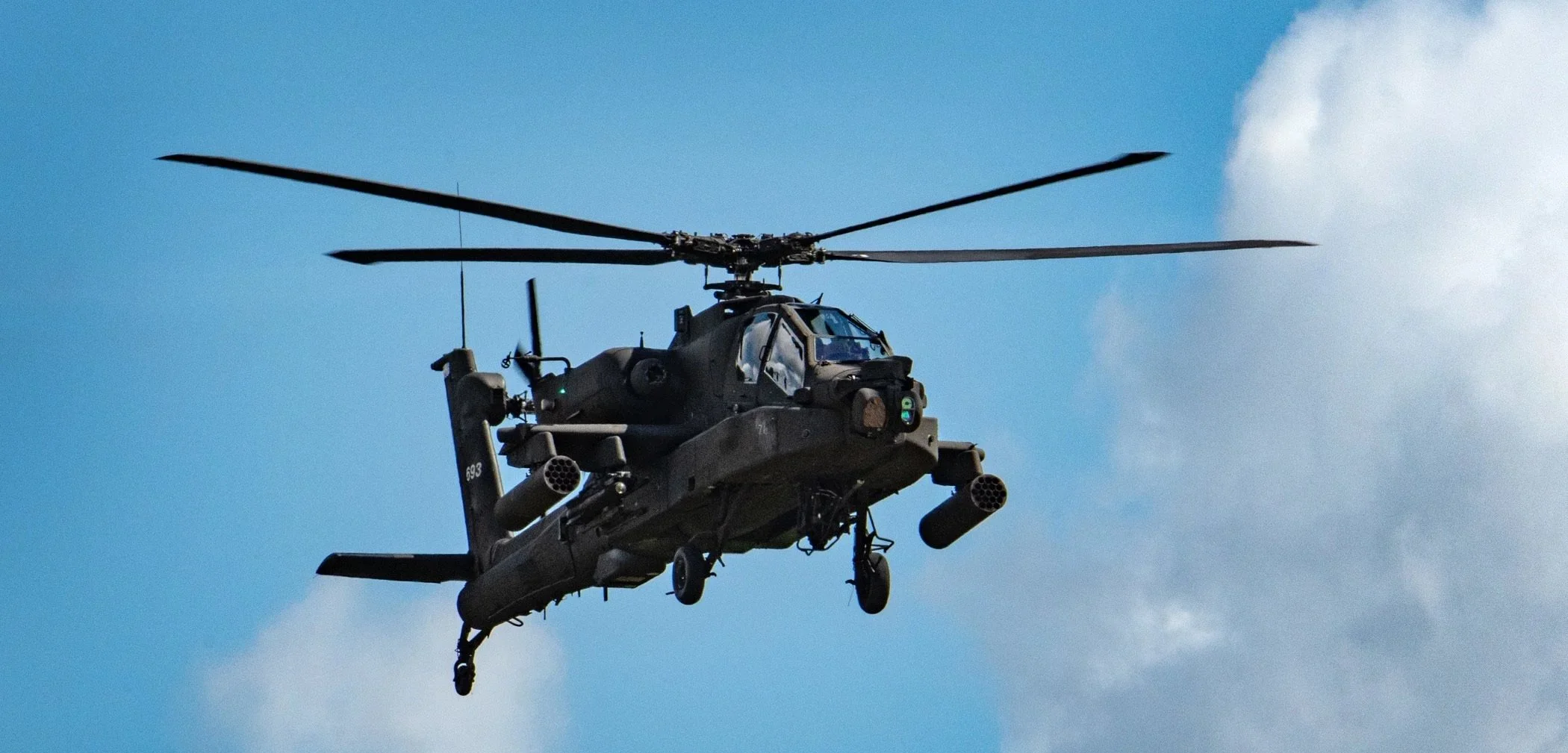
Last Takeoff
December 28th, 2016
I am walking toward the hangar with my overnight bag to take duty. It's my first day back to work after Christmas, and I am hoping for a nice, quiet duty shift.
Just before I get to the hangar, I see an AH-64 Apache air taxiing for takeoff. The Texas National Guard's 1-149th Attack Battalion is in the hangar right next to us, so we often see these incredible helicopters flying around. I stop at the fence and watch the Apache in awe. It is the meanest looking helicopter there is, and it's strangely quiet as it takes off. I reflect for a minute on how lucky I am that I get to see things like this and fly helicopters for a living.
I am having a hard time coming to work after a particularly lonely Christmas. Natalie and I spent it alone and didn't really do anything. It was another sad reminder of how fractured our family still is and the reality of being a duty standing pilot. I was feeling sorry for myself, but watching that Apache take off snaps me out of it, and I'm excited to do some flying.
I drop off my overnight bag in the locker room and head to my office to do some preflight planning. I check the weather, NOTAMs, and weight and balance, and ensure everything is ready to go for our duty shift before heading down to the OPCEN.
Our whole crew is assembled, but the offgoing crew isn't there because they are flying on an uncorrelated “MAYDAY” out east. The Operations Duty Officer (ODO) begins the passdown brief and starts going through the checklist. In the middle of the brief, the phone rings, and we pause for the ODO to pick it up. I can't hear what the person is saying on the other end, but I can tell something is bad. The ODO is frantically scribbling on a pad of paper and says, “Roger, I'll let the crew know.”
The ODO abruptly gets off the phone and says, “One of the Apaches crashed in Galveston Bay.”
I just watched its last takeoff.
“The offgoing crew is being diverted and should be on scene soon. As soon as they are out of fuel, Sector wants you on scene.”
Looking at the offgoing crew's takeoff time, I know they won't have much time on scene. We need to hurry. We wrap up the brief and start getting ready to launch.
I plot the position, and it's in Galveston Bay, almost onshore in front of the Bayport Cruise Terminal. The only information we have is that an Apache crashed, its position, and that there were two people on board.
We head out to the helicopter and take off shortly after the duty brief. On the way to the scene, we see the offgoing crew pass us in the opposite direction on course rules.
It is a short flight, and we have no idea what to expect when we get on scene. Sector has no additional information yet and hasn't given us a search pattern. The position seems strange, being so close to shore, so I am hoping we are headed to the right spot.
It doesn't take long to find what we are looking for.
Directly in front of the cruise ship terminal, at the position we were given, we see a large, dark object just below the surface. Several police and fireboats are already on scene.
As we get closer, we can see the landing gear and wheels of the Apache sticking straight up out of the water. We also notice what looks like a completely intact rotor blade a few hundred yards away onshore. I immediately get a sinking feeling.
We establish communications with the surface vessels, and they report that nobody has been found yet and no divers have been able to get near the wreckage.
We have a discussion in the helicopter with the rescue swimmer, and he is willing to be put into the water. Our manuals are very strict about rescue swimmers not entering submerged vessels and require them to maintain a handhold on the outside of the vessel.
I know that if we don't see anything in the Apache's cockpit, we need to go and look for the pilots who might still be alive.
I really hope they are alive.
We pull into a hover near the wreckage, and I can see the mangled, bent metal leaking fuel and oil. It's hard to look at, but we need to focus. We deploy the rescue swimmer and watch him swim toward the wreckage. We see him go just under the surface into the murky brown water. He swims around the wreckage and submerges several times.
After a few minutes, he calls us on the radio and tells us that he found the bodies in the cockpit. We have a hard time hearing him, but what he describes is horrific. The damage is extensive, and it's immediately clear that neither pilot survived.
It's clear this is no longer a rescue mission.
He says he is going to stay in the water for a while, helping the police and fireboats with recovery. We are of no use in the helicopter right now, so we land on the concrete pier of the cruise ship terminal to conserve fuel.
Once on deck, I climb out of the helicopter and walk away from the noise to call CDR Sanborn and tell him what happened.
It's hard to talk about what we've seen, but he assures me we did the right thing and did everything we could.
We stay there with the helicopter running for a while, waiting to hear from our rescue swimmer. Eventually, he tells us that another dive team has arrived and the fireboat will take him over to us on the pier. We get him on board and are released from the case for a somber flight back to Ellington Field.
Once we land back at the air station, we conduct a thorough debrief, and I ask how everyone is doing. Everyone says they are doing fine and are good to continue standing duty.
I tell them that I am also fine, but I am not sure that I am.
This crash brings back a lot of memories of other crashes, and without knowing all the details of what happened, I can't help but try to piece it together.
Seeing an intact rotor blade away from the main crash site tells me it likely separated in flight, resulting in a catastrophic crash.
That scares me.
It scares me because I believe that if I prepare enough, study enough, and honor my profession, I am offered some protection from a mishap. But what if something happens that no amount of preparation can prevent?
The thought of two pilots facing a situation they could do nothing about terrifies me. They could have been the best pilots in the world, but a helicopter won't fly if it's missing a rotor blade.
That thought, and the image of the helicopter taking off only to become crumpled metal with its wheels sticking straight out of the water, keep me up most of the night.
The next day, the Commanding Officer calls me.
I have a ton of respect for the Commanding Officer. He is extremely professional, a great leader, and an awesome pilot. When he asks me how I'm doing, I do what I always do and tell him I'm fine. He's not really buying it and tells me he's having everyone from both crews come in for CISM (Critical Incident Stress Management) the next day.
I try to tell him that I don't need it, and he says, “George, you might feel fine now, but I need to make sure that you are all okay. I also want you to be there to support your crew and be there with them if they need it. Can you do that for me?”
“Yes, sir.”
I think back to the other terrible cases and crashes I have responded to. We all just said we were fine, went our separate ways, and I never healed from many of those wounds. I buried all the feelings and never spoke of them. Now, after talking to the CO, I feel selfish because I didn't think about the rescue swimmers or the other crew and what they might have been through the night before.
The CO is right, and I need to be there for my crew.
The next day, we all gather together at the hangar. They make a big deal out of us coming in civilian clothes and it being a safe space to talk about how we feel.
I am hating every bit of it.
The CISM coordinator introduces himself, and we all sit around him in a circle. He starts by talking about all the different resources available to us if we are struggling. He goes on for a little while about mental health and trauma. He tries a few times to get some audience participation, but nobody is falling for it.
Eventually, he asks how everyone slept after the case. That finally gets people talking. It is a pretty low threat question, and nobody needs to discuss their feelings.
I am surprised to hear that almost everyone has had a hard time sleeping since the case.
The coordinator discusses some more things we might have experienced, including withdrawal, distraction, irritability, and heightened emotions. This starts to get everyone talking. Some of the crew discuss how they have had trouble focusing, how they have been distracted, and how they have been short with their wives or children.
Eventually, we all feel safe enough to talk about what happened and how it has affected us.
For so long, I thought I was the only one who struggled after these experiences. It felt like something was wrong with me because I felt the losses so deeply.
After sitting together in CISM, I realize that other people feel these same losses. Other people have also been struggling, and I was never alone.
I am glad the CO asked me to be there for my crew when, really, I needed them to be there for me. I have needed them for years. I am happy that the culture in the Coast Guard has begun to shift and that people are more willing to be vulnerable about how some of the hard days affect us.
A few days later, I learn that one of the other Coast Guard pilots in Houston had met one of the Apache pilots before he passed away. She got to talking with the Apache pilot at the local civilian flying club, and he told her he was trying to get his private pilot's license so he could take his kids flying. He wanted to fly them around the area and show them all the Christmas lights.
Hearing about him, his children, and the plans that he had makes it all too human.
These pilots had so much life left to live. They were only 32 and 33 years old.
At 31 years old myself, it makes me stop and think. I wonder what other hopes and dreams they had for the future, what things they never got a chance to say, and what they left unfinished. I realize how lucky I am to still be here and what I might regret if tomorrow isn't promised.
I think about my father.
We have been estranged for over four years, but a few months ago, he wrote an email to the family. The subject line read only “Sorry.” It's several paragraphs of apologies and taking ownership of his role in what happened to the family. His message concludes with,
“If nothing else, just know that I am sorry for everything and love you guys now, always loved you before, and will love you forever. And I miss you all.”
I still need to heal, and so does the rest of the family. I'm not quite ready to forget the last four years because of an email, but I can't stop thinking about it. I can't stop thinking about how I was so angry for so many years, wishing he would just apologize. I can't stop thinking about how much has changed since we last spoke.
More than anything, I can't stop thinking about those two pilots, barely older than me, who will never get another chance to be with the people they love.
I don't know how long I have, but I realize that whatever time I do have left, I want my family to be together for it.