One More Pass
September 4th, 2016
In June of 2016, I report to Air Station Houston. I have never been to Texas, but Natalie is not interested in going anywhere cold, so it seems like a good enough place to be stationed. What I am most excited about is that CDR Scott Sanborn is the Operations Officer. I have always looked up to him and admired him as a leader and a pilot, so I jumped at the chance to work for him.
When I check into the unit, I am surprised by how small it seems. HITRON is one of the largest Coast Guard aviation units, and Houston is one of the smallest, so the contrast is jarring. I am also surprised by how I am treated. I was the most junior person when I checked into Borinquen, and since HITRON only has pilots who are on their second tour or beyond, I was also the most junior person at HITRON. It was like repeating my freshman year at a new school.
Now, all of a sudden, I check into Houston as a third tour pilot and instructor. They make me a department head, I am at all the important meetings, and I am given even more responsibility than ever, but I still feel like I don't belong.
On one of my first few days, I sit down and talk to CDR Sanborn, and he tells me how excited he is that I came to Houston. We talk about what I need to do to get fully qualified for duty again. We also talk about my instructor qualification, and I confess that I am a little nervous because I have only instructed other second tour pilots on airborne use of force. He says all the right things and assures me that I will be ready.
I also explain to him that although I am a third tour pilot, I have very little experience flying in bad weather. Borinquen had beautiful weather all the time, and the HITRON mission had to be executed in visual meteorological conditions. Houston gets a range of weather, from fast moving thunderstorms, low fog, hurricanes, and everything in between.
CDR Sanborn again assures me that I will be fine and that I just need to know my own limitations when it comes to weather. We discuss his training philosophy, “Aggressive, safe training saves lives,” and I can see how passionate he is about his training program at the unit.
CDR Sanborn was in Mobile when CG6535 crashed into Mobile Bay, and I can see how that experience has forged him into one of the most professional pilots I have ever seen. He embodies “Honor Our Profession.”
He lights up when he tells me about his “Focus on Proficiency” initiative, where, for one week every quarter, there is a theme that we focus all our briefs and training flights on. He does a deep dive into one aspect of our flight training. Topics have ranged from aerodynamics, hoisting, search and rescue, and urban search and rescue.
He also tells me that, as OPS, his biggest fear is a hurricane with a large scale flooding event similar to Hurricane Katrina. He has spent his time as OPS preparing the unit for that scenario. He pioneers urban search and rescue hoist training and develops a robust confined area landing program to practice landing on roads or unprepared surfaces throughout the area of operations.
He drafts a hurricane booklet every hurricane season with contingency plans for hangaring aircraft, communications, hazards, and any other useful information. He sends the published booklet to all neighboring units to help them prepare.
I am excited after talking to him. It is clear that Houston has the best OPS boss and training program in the fleet. I am ready to learn everything I can.
Over the next few weeks, I study nonstop, fly my area familiarization flights, learn how to land on oil rigs, practice day and night hoisting, and complete a search-and-rescue check ride to be requalified to stand search and rescue duty. I am excited to be standing duty again, but these past few weeks have flown by, and I hope I am ready. I am back in the world where people having the worst day of their lives need me to be at my best.
One of my first duty shifts back as aircraft commander is over Labor Day weekend, which is historically very busy. We come on duty at 1500, and the first few hours are quiet, with beautiful sunny skies. As the evening starts winding down and I start getting ready for bed, the alarm sounds through the hangar.
“Now put the ready helo on the line. Put the ready helo on the line. There is a report of a capsized vessel with multiple people in the water in Galveston Bay.”
I run to the OPCEN, and the duty officer tells me it's a confirmed case, with some of the people from the boat as the reporting source. I grab the lat and long and run out to the helicopter, where my crew is already preflighting. I brief them on the case, and we all know this is urgent.
Moments later, we are airborne, and the position is only fifteen minutes away. Things are happening fast, and I rush through all our various briefs and configure the aircraft in case we need to hoist some people in the water.
We hear on the radio that a 45 foot small boat from Station Galveston is also inbound and will likely arrive on scene before we do. It is fairly dark, with only a small sliver of moon low in the west, and East Bay doesn't have much cultural lighting. Our night vision goggles are straining as we head into the darkness toward the last known position.
We can pick up the flashing blue lights of the small boat in the distance just as we hear them come over the radio. “Sector, 45760, be advised we are on scene at this time and have recovered zero three PIW. There are two remaining PIW not accounted for, an adult male and a two year old child.”
I get a sinking feeling in the pit of my stomach. Everything I needed a break from comes crashing back in an instant, but I have to shake it off and continue the mission. This is going to be a long and sad night, and the crew goes silent as we all come to the realization that finding a two year old in this darkness is nearly impossible.
As we are approaching the vessel and about to overfly the CG small boat, they shoot up a parachute illumination flare, and we have to bank hard to the right to avoid it.
We are flying at 500 feet over the water, away from the vessel and the last known position of the people in the water. I am looking down and adjusting the radios to try to establish communications with the small boat that's shooting at us. I tell my copilot to keep flying west until we can get comms and let the parachute flare descend.
A couple of minutes later, the rescue swimmer, Luke Johnson, calls out over the internal comms. “Mark, mark, mark! There's something in the water!”
I race for the mark button on our CDU, record the position, and input it into our flight plan.
“What did you see?”
“I'm not sure. It looked like splashing.”
“Did anyone else see anything?”
“Negative.”
“No, sir.”
“All right, let's come down to 300 feet and do another pass.”
The copilot descends and does a lap around in the darkness, back toward the mark point. We fly directly over the point at 70 knots.
“We're flying over the mark point now. Can anyone see anything?”
Nobody sees anything.
“Let's come around again.”
We make another lap. Nothing.
We still haven't been given a search pattern, so I say, “Let's try one more pass.” Again, we see nothing but darkness and no signs of life.
Then I ask Luke, “You think we should continue on and get a search pattern from Sector? We're at least a mile from the boat and where they found the other people. What do you think?”
Luke replies, “Can we do one more pass? I just want to make sure.”
“Sounds good. Let's do it.”
I take the flight controls, maneuver around toward the position, and descend to 75 feet above the water. I slow to an air taxi as I approach our mark point.
Then, all of a sudden, something appears in front of the helicopter out of the dark water. We all see it at the same time when the landing light hits it.
A man treading water and holding a two year old across his chest.
I can't believe it.
I pass the controls back to the copilot, and he slows to a hover to keep the survivors in view and outside the rotor wash. I immediately get on the radio and try to tell the small boat what we've found.
As we pull into the hover, the wind is off our tail, and we are heavy. We don't have much power margin, and I am staring at the torque on our display as it moves into the yellow and approaches our maximum. As I am trying to talk on the radio, I am blocking the collective with my left hand to try to avoid exceeding our torque limit.
Then my copilot says to me, as calm as can be, “Are you blocking the collective?”
I reply, “Yes, you're at 98 percent torque.”
“Okay, but we are still descending.”
I look at our radar altimeter, and sure enough, it shows us descending slowly toward the water.
I stop blocking the collective and tell him, “You're right. Pull what you need.”
A moment later, we hear a “dink” over our headsets to let us know we have exceeded our maximum allowable torque and damaged the aircraft, but at least we aren't descending.
We sit there for a minute with the power holding above our maximum allowable torque, and it's a bad situation. We are too heavy to hover, but we need to keep the survivors in sight.
We decide to transition to a slow air taxi and try to point into the wind to get more favorable power. We arc around the survivors 180 degrees and point into the wind, giving us just enough power to hover.
This all happens in just a few moments but feels like an eternity as we watch this man and the two year old in the water. The current is rapidly pushing them toward the Houston Ship Channel, where enormous tanker ships charge through the dark water in Galveston Bay.
Once we are stable in a hover with barely enough power, we realize we can't hoist anybody, and it would be hard to even deploy Luke to the water, so I get on the radio with the small boat. I vector them toward the survivors and light up their path with our landing light.
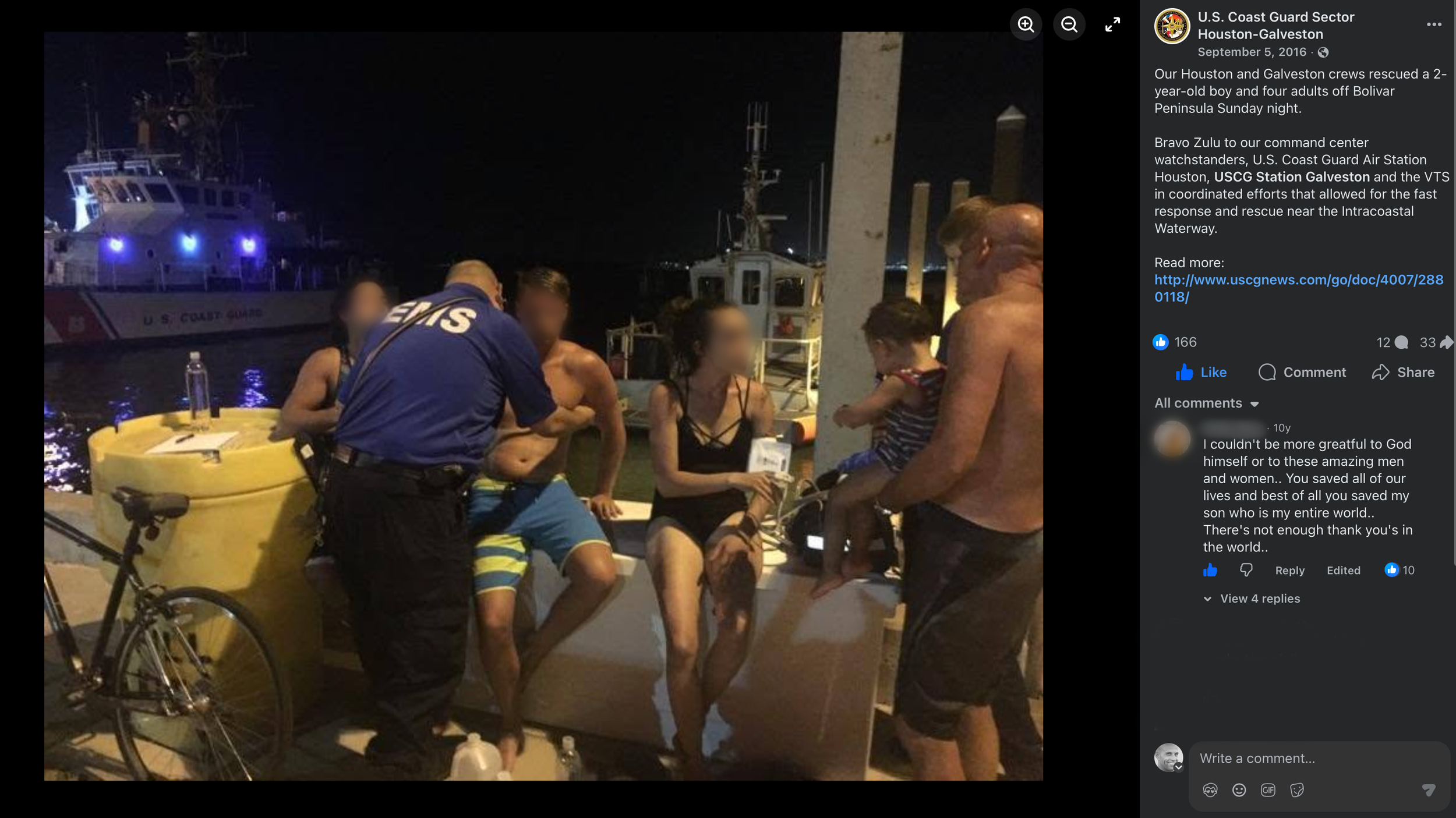
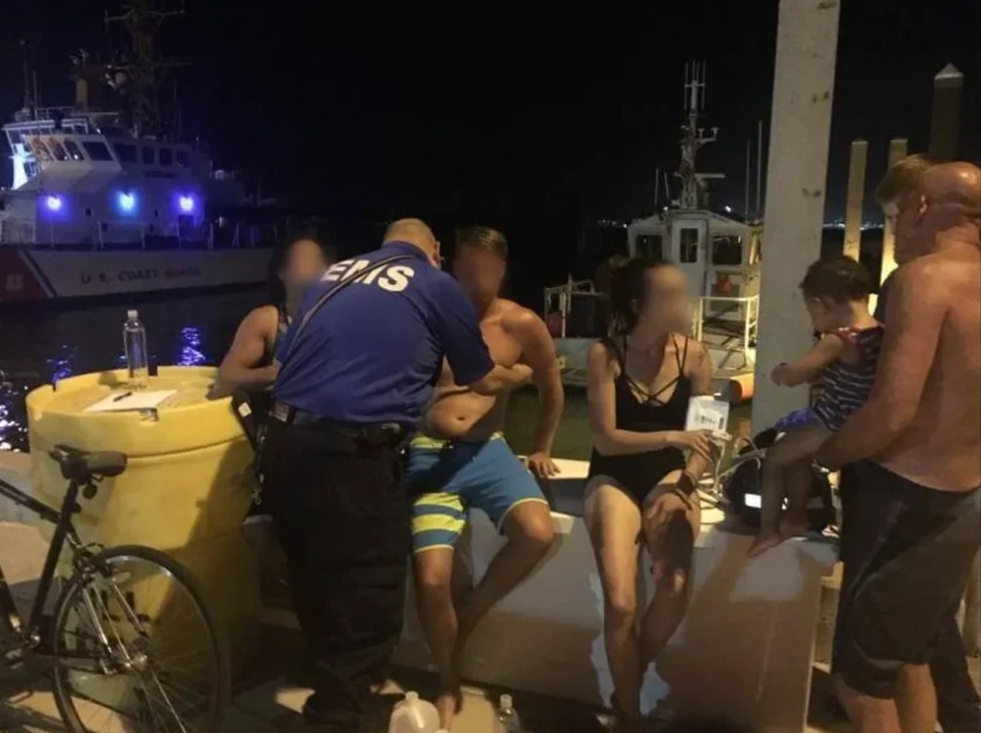
We watch the boat speed toward us as I continually give them distances and headings. In just a couple of minutes, which seem to take forever, the small boat reaches the survivors and brings the man and the two year old safely on board. I am still in disbelief.
I still can't believe Luke saw them from that altitude in the darkness. After three passes over the exact same position, none of us could see what he saw. Despite that, he was confident enough to ask us to come around one more time.
Had Luke not seen something in the water and been assertive enough to speak up, we would have continued toward the last known position and started our search pattern. We never would have found them as they drifted rapidly toward the shipping channel.
I will always be grateful that Luke trusted what he saw and asked for one more pass. Those two people are alive because he did.
The very next morning, we rescue two more people from a capsized vessel and respond to a sportfishing boat that is sinking. The news comes to interview us, and we receive a personal thank you email from the district admiral for our efforts during that duty shift, but none of that matters to me as much as what happened the night before.
I remember all the people I've searched for and never found. I remember all the families waiting on beaches with flash lights, watching us fly by and desperately hoping we find their loved ones. I remember all the times I've returned to the Air Station feeling awful because somebody's miracle never happened.
Last night was different. A two year old boy is alive and at home with his family. He gets another chance at life, and his parents get to watch their son grow up.
I have spent my entire life chasing a dream, failing, picking myself back up, and wondering if I would ever make a difference. I have spent years trying to honor my profession and become the pilot people can count on when they need it the most.
I spent my whole life wanting to help people when they needed a miracle to save them. Last night, thanks to Luke and our crew, I got to witness that miracle.