He Couldn't Have Known
April 17th, 2010
Back in Puerto Rico, I complete my area familiarization flights, which include flying to St. Thomas to eat lunch and looking for waterfalls in El Yunque. During my first few flights, I am in awe of how beautiful Puerto Rico is from the air, and I see how it earned its nickname, “La Isla del Encanto,” the island of enchantment. Once I complete my area familiarization flights and finish my check-in process, I am ready to stand duty as a qualified copilot.
On Saturday, April 17, 2010, I arrive at Air Station Borinquen for my first duty day. I’m overwhelmed with nervous energy and excited to finally fly real Coast Guard missions. Duty starts at 1600 and lasts 24 hours. During that time, we are expected to meet a 30 minute launch window, meaning from the initial call for a rescue, we need to be airborne within 30 minutes. I arrive early to check weather, NOTAMs, weight and balance, and set up all my gear. We do a crew briefing and preflight our ready helicopter. After that, I anxiously check some emails and try to catch up on work. There isn’t a lot to do, but I try to stay busy. I eat dinner, watch some TV with the Aircraft Commander in the wardroom, and go to bed.
I have a hard time falling asleep in the duty room. All I can think about is the SAR alarm going off and needing to run to the helicopter. I worry that, for some reason, I won’t be ready. I overthink every possible thing that could go wrong, and I am paranoid that I am forgetting to do something or that I will sleep through the alarm. I toss and turn all night. At one point, I jump out of bed absolutely convinced the alarm went off, but then I look outside, and it is totally dark, with everyone else sleeping soundly.
After staring at the ceiling for hours and getting a horrible night’s sleep, we have an early wakeup to fly a law enforcement patrol. We search the Mona Passage, looking for drug smuggling vessels or suspicious activity. Even though we are mostly looking out at nothing but crystal clear water, it is nice that this flight isn’t a graded event that I can fail. Instead of being grilled on procedures and emergencies while combatting a helmet fire, we fly the mission as a crew, and it is a tremendous relief. After an uneventful two hours of not finding any bad guys, we land back at Air Station Borinquen. There is still a lot of duty day left, so I spend some time working out and studying.
Then it happens.
Just after 1000, the SAR alarm blares through the giant cement hangar, and the watchstander pipes, “Now put the ready helo on the line. Put the ready helo on the line. There is a missing diver off Cabo Rojo. Put the ready helo on the line.”
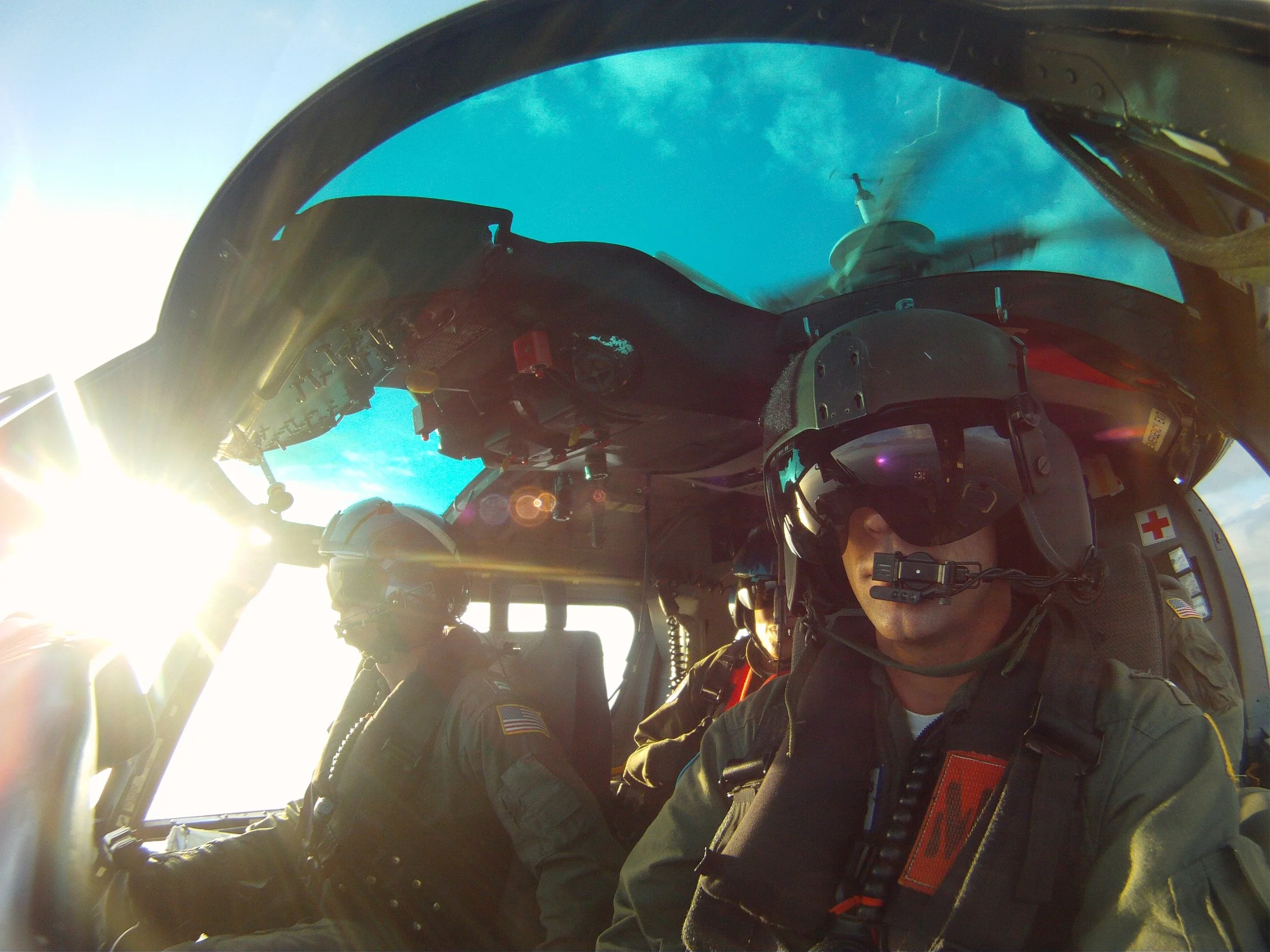
I grab my gear, put on my survival vest, and run out to the helicopter, which is still parked inside the hangar. I do a quick preflight walkaround. My heart is racing, and I am taking deep breaths to try to calm myself down. I strap into the left seat as the line crew tows us out to the flight line. I grab the tri-fold checklist and immediately start flipping switches for the before starting engines checklist.
As the Aircraft Commander meets me at the helicopter, I start the engines. I am nervous, but my training has been so effective that I easily run through all the procedures. Our crew functions in unison as we prepare to take off as fast as possible.
Then, over the radio: “Now stand down from SAR. The diver has been located.” We shut down the aircraft, and I feel the comedown as the adrenaline rush subsides. We tow the aircraft back in, and I try to calm down. There are still five more hours of duty. I eat some lunch and relax in the wardroom.
Just before 1400, the SAR alarm breaks the silence again, and I feel another immediate surge of adrenaline. I jump off the couch and start heading toward the helicopter.
“Now put the ready helo on the line. Put the ready helo on the line. Person in the water off Loíza. Put the ready helo on the line.”
I run through the same steps as before and ride the helicopter out of the hangar. I put my helmet on, and it is still soaked in sweat from the last time we scrambled to take off. I get the engines started as the Aircraft Commander and rescue swimmer run out to the helicopter. Again, my training takes over, and I cruise through the checklists despite the excitement. Once the Aircraft Commander gets in the helicopter and connects to the internal communications system, or ICS, he briefs us with more details on the case.
“A father and son were out on two separate Jet Skis. The father, a 49 year old male, swamped his Jet Ski and lost power. He drifted into the heavy surf and is floating in the water with a life jacket on.”
We do a quick risk assessment and take off. We aim toward the last known position, and it is about a 35 minute transit until we are on scene. We can hear all the radio chatter between Sector San Juan and the Coast Guard small boat. The small boat is only about 15 minutes out and will beat us to the person in the water by at least 15 minutes. I assume that we will only provide cover, but our Aircraft Commander begins all the various briefs while I fly to the scene.
He runs through a full hoist briefing and discusses a plan with the flight mechanic and rescue swimmer for getting the swimmer to the survivor. He gives me tasking to help him monitor power, altitudes, and radios. We run through some performance calculations and determine that once we get on scene, we will likely be too heavy to hover and might need to jettison fuel before we can effect a rescue. Everything is happening fast, but we have covered all of this in our training.
The small boat gets on scene first and briefs Sector on the situation.
“Sector, CG33137. Be advised, the survivor has been sucked into a cave area and is surrounded by cliffs and jagged reef. There are five to eight foot seas and 15 knot winds, so the waves are throwing the survivor into the cave wall. We won’t be able to get the boat in there safely to the survivor, and there is no access from land. The helicopter will have to hoist him.”
“CG33137, Sector. Roger. Good copy on all. Break, break. CG6582, did you copy?”
Our Aircraft Commander calmly replies, “Sector, CG6582. Good copy on all. 6582 is eight minutes to on scene.”
We run through another brief and quickly perform the landing hover and prior to 200 foot checks. Once on scene, we can immediately see the survivor, and we report to Sector. He is floating with a life jacket on, but he is being tossed by five to eight foot breaking waves into the razor sharp cliff made of dry reef.
As the waves crash into the wall, water and spray shoot into the air. Then, as the water sucks back off the wall, it forms with the next wave, making it grow to an even greater size before rearing back and violently smashing into the reef again.
It is ugly.
Once we have the survivor in sight, we immediately pull into a hover a couple hundred feet away and rapidly go through the fuel jettison procedure to get light enough to hoist the survivor.
After that, we prepare to deploy the swimmer and pull into a hover over the angry whitewater. As I look down through the chin bubble, I can see the whitewater swirling, mixed with sand and rocks, forming dangerous eddies and currents everywhere. It is the type of water I would never want to get in.
The Aircraft Commander asks the swimmer, “How do you feel about going down there?”
Without any hesitation whatsoever, he replies, “Ready to go, sir,” as he is already climbing up to the door.
The Aircraft Commander continues, “Rescue check part two for direct deployment of the rescue swimmer to the survivor.”
A moment later, the flight mechanic replies, “Rescue check part two complete. Ready aft for direct deployment of the rescue swimmer.”
“Check swimmer.”
“Swimmer ready.”
“Conn me in.”
Everyone is acting on pure instinct and relying on their years of training.
Shortly after being lowered, the swimmer cuts through the tumultuous seas unfazed and grabs the survivor. He connects the survivor to the rescue device and gives the flight mechanic the ready for pickup signal. The aircraft lurches as the hoist lifts the swimmer and survivor out of the water.
I monitor power as I make a call to Sector that we have recovered the survivor.
I look back at the survivor as he is being pulled into the aircraft. He looks like a rag doll, totally exhausted and nearly collapsed in the arms of the rescue swimmer. He is covered in cuts and blood from impacting the reef.
He is alive.
I report his condition to Sector, and we elect to fly him to Centro Médico Hospital so he can get his injuries treated. Once we complete the rescue checklists and level off, I look back at the survivor. I give him a nod and a thumbs up, and he nods back at me. He looks relieved to be out of the water, but also like he is about to pass out from the exhaustion of fighting for his life against the unyielding ocean. The rescue swimmer triages his wounds and tells me over ICS that he is lucky and has no major injuries. I tell him that we are 15 minutes out from the hospital, and I report that to Sector over the radio.
The next 15 minutes are extremely busy as we configure the helicopter for landing at the hospital pad and brief the approach, all while talking to Sector and San Juan International Airport as we get permission to transit their crowded airspace. It is hectic, but we all know exactly what jobs we need to do, and we work as a team to get our survivor to the hospital safely and as fast as possible.
On short final, the Aircraft Commander passes me the controls and tells me that I’ve got the landing. It is a small ground level pad with few obstacles, but I have to be precise to land on the pad and not send us into the grass or parking lot. I work my way down slowly, death gripping the controls, and we touch down on the pad. The rescue swimmer and flight mechanic help carry the survivor out of the aircraft and into the hospital. At that moment, as I see him get off the aircraft, I start to feel myself getting emotional, but I have to keep it together. I still have to take off from this pad and fly home.
The mission is not over.
A few minutes later, the flight mechanic and rescue swimmer are back on the helicopter, and we prepare for takeoff and our flight home. I pull power and lift us vertically off the pad and transition to forward flight as soon as we are clear of all the surrounding obstacles. The return flight is a blur, and I desperately try to stay focused on all the things that still need to happen before we land. Eventually, we make it back, shut the aircraft down, and the mission is complete.
The adrenaline subsides, and I am flooded with emotion. I keep my dark visor down to hide the tears in my eyes as I realize I just lived the moment I have spent my entire life dreaming of. The moment I drew pictures of as a boy. The moment I dedicated my life to. The moment I thought so many times would never happen. The moment our crew made sure a father would be able to go home and see his son.
I wonder what he thought when he looked up at me in the aircraft. I wonder if he could tell how much that moment meant to me.
There is no way he could ever know what I had to go through to be there for him on that day when he needed us. He couldn’t possibly know about the little boy drawing helicopters and wearing uniforms to school photos, or the swab who got scared and quit, or the cadet who almost failed out and tried desperately to get kicked out, or the fledgling pilot who repeatedly failed but fought like hell to get his wings. He couldn’t have known any of this.
All he knew was that when he was in trouble and out of options, the helicopter came, and somehow I was in it.