LEARNING TO FLY
July 24th, 2008
I’m walking down the ramp for the first time toward my aircraft’s parking spot. There are bright orange planes parked everywhere. It is bright, loud, sweltering, and reeks of exhaust fumes. I have waited my whole life for this, the moment I saw in all my favorite movies when the pilot struts to their aircraft in a flight suit, carrying a helmet and gear, peering steely-eyed through aviator sunglasses, dog tags rattling, and ready to take on the world. I should be excited, but it is the last place I want to be.
This moment is not the beginning of my flight school experience. It started months before in Introductory Flight Screening, or IFS.
“Attrition is an expensive by-product in pilot production. Introductory Flight Screening (IFS) is a program established to expose Navy and Marine Corps student pilots to aviation in an aircraft at one quarter of the operational expenses of the Navy’s Primary training aircraft, the T-34 Turbo Mentor. The objective of IFS is to decrease drop-on-request (DOR) and flight failure (FF) rates in Primary flight training by identifying student pilots who lack the determination, motivation, and aeronautical adaptability required to succeed in training.” — Peter L. Morrison
IFS is an inexpensive way for the Navy to determine whether someone might quit or fail out of flight school. During IFS, the Navy sends flight school students to local civilian flight schools to fly slower, less powerful aircraft.
“IFS has several milestones required for successful completion. The Student Naval Aviator (SNA) must fly at least 24 flight hours, but no more than 25 hours, to include three solo flights, with one being a cross-country event. The first solo must be flown by the 15-hour mark, which can be extended to 17 if the command review board approves.” — Peter L. Morrison
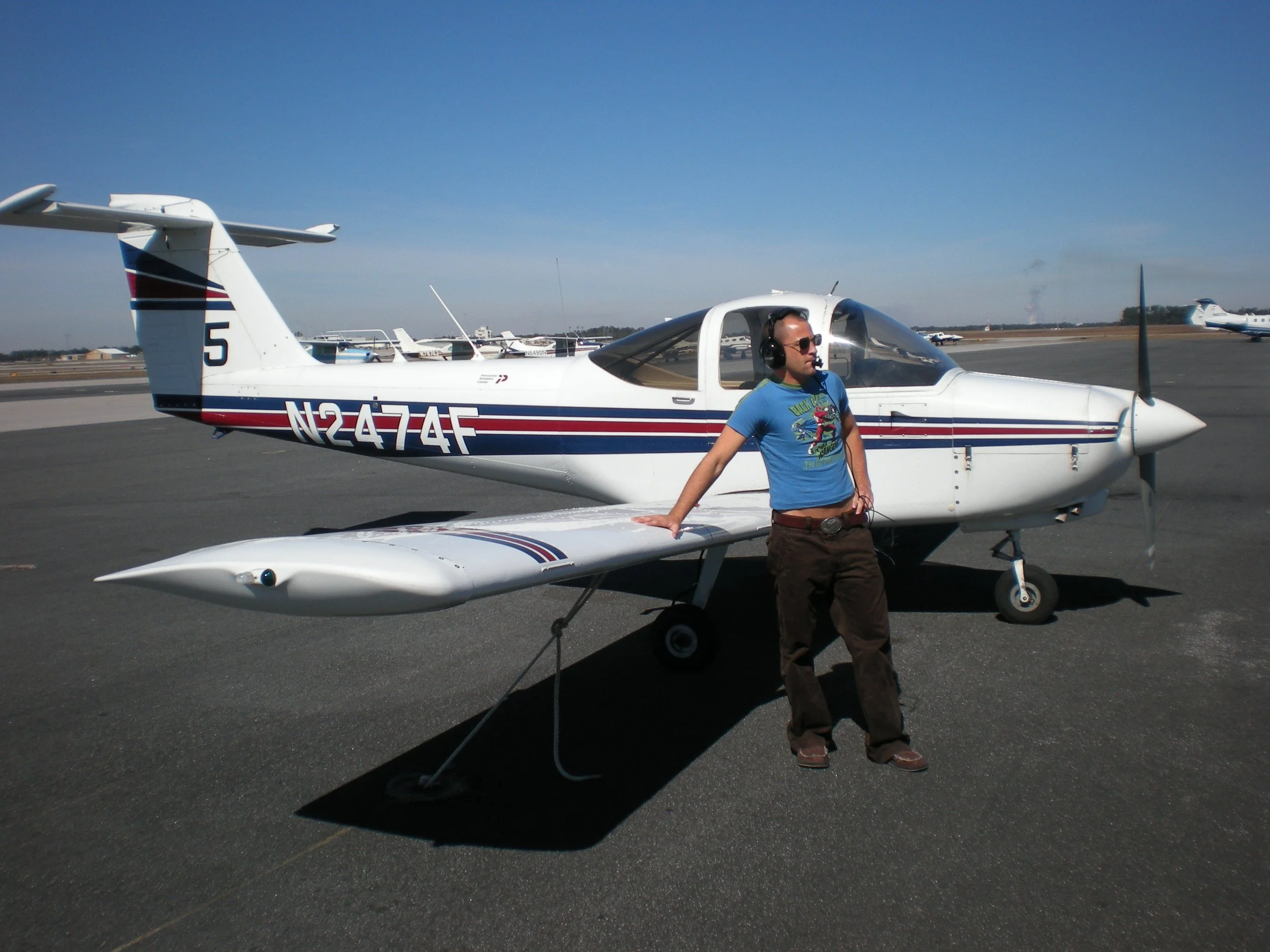
I begin IFS training at Pensacola Regional Airport and fly the Piper PA-38 Tomahawk. The PA-38 is a two-seat, low-wing, T-tailed training aircraft produced from 1978 to 1982. The Tomahawk is introduced to me as the “Traumahawk,” aptly named for its terrible reputation.
“Since the two-seat trainer was introduced, it has been involved in 51 U.S. stall-spin accidents that resulted in 49 deaths. It also has been the subject of numerous pilot reports regarding its unpredictable stall-spin characteristics and tendency to enter flat spins. A recent report by the AOPA Air Safety Foundation found that the Tomahawk stall/spin accident rate was nearly double that of comparable training aircraft such as the Cessna 150/152, Beech Skipper, and Grumman AA1. The NTSB’s own comparison between the Tomahawk and the Cessna 150/152 found the Tomahawk’s fatal stall/spin accident rate was from three to five times higher than the Cessna trainer. The NTSB noted that at least seven of the Tomahawk stall/spin accidents that it has investigated ‘involved inadvertent spins that occurred during instructional flights while attempting slow flight or stall training.”— Sweeny, Michael, “NTSB recommends new round of Tomahawk tests,” July 25, 1997
I learn early in flying the Traumahawk that I have difficulty landing. My technique is to panic whenever I get close to the ground, totally freeze up, and hope the plane somehow lands itself. Every landing is different. I bounce off the landing gear, land too fast, too slow, or crooked, nose high, nose low, and never over the correct spot on the runway. The only thing my landings have in common is that they are all terrible.
It is clear that I will not make the 15-hour mark for my solo because I am a danger to myself.
Luckily, CAPT Pettitt negotiates extra training hours for me, and I eventually meet the absolute minimum standard to be “safe for solo.” In aviation, it is said, “Any landing you can walk away from is a good landing.” I am putting that to the test. My first solo flight is uneventful, but on subsequent flights, I inadvertently fly into a storm and essentially crash-land with my wing and tail hanging off the runway. On my cross-country flight, I get disoriented and try to land at the wrong airport, which happens to be where the Blue Angels practice. I complete IFS but know I lack the “aeronautical adaptability required to succeed in training.” About 5 percent of Student Naval Aviators fail this training phase and never realize their dreams of becoming naval aviators. I belong in that 5 percent.
So, as I walk to the T-34 Turbo Mentor for the first time, I don’t appreciate that I am on my way to achieving my childhood dream. I am wondering how on earth I will fly a 550-horsepower, fully aerobatic turboprop aircraft that flies over 150 knots after I demonstrated I couldn’t handle the 112-horsepower Traumahawk that could barely make it to 100 knots. I am terrified, but I have two things going for me.
CAPT “Primetime” Pettitt believes in me.
He is a legend in Coast Guard aviation, and for some reason, ever since my interview with him, he has seen something in me. After IFS, he knows I am discouraged and sends me this message in an email:
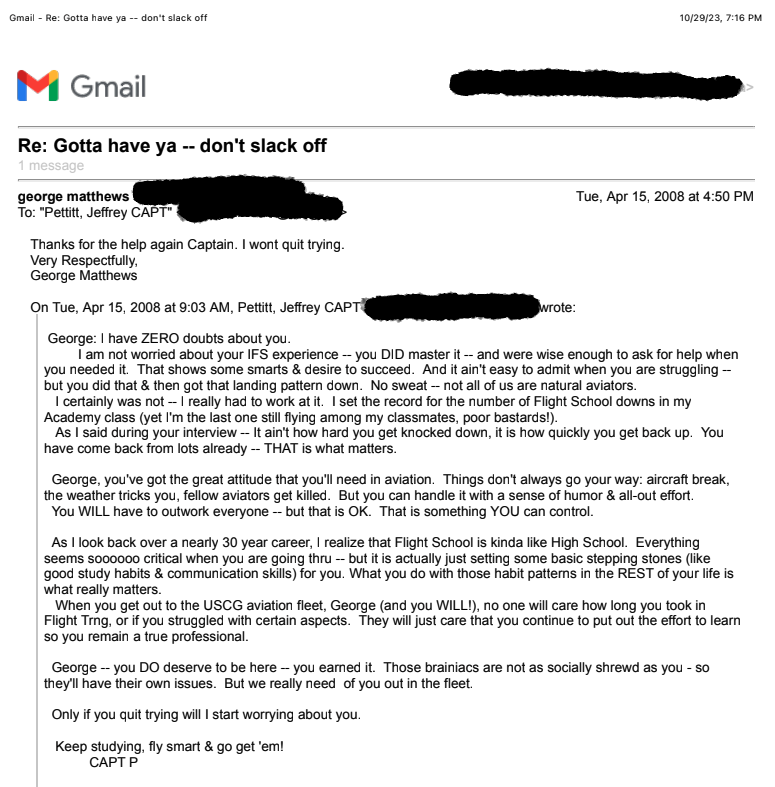
His words give me the courage to continue when I doubt myself, and I don’t realize at the time how true his words are. More than anything, I want to make everyone proud: CAPT Pettitt, the legends in the Branch, my Company Officer, Duby, and all my other friends and family who believe in me.
I have a plan.
Everyone ahead of me in flight school mentions that the key to success during the first flights is to get the aircraft started as fast as possible. It is August in Milton, Florida, and temperatures regularly hover above 90 degrees with oppressive humidity. On the paved ramp, with aircraft spitting exhaust, it is much hotter. Inside the cockpit of an aircraft baking in the sun all day, it is likely the highest temperature recorded on Earth. Climbing into the cockpit with a fireproof flight suit, boots, survival vest, gloves, and a helmet, you are basically trying to cremate yourself. The faster you can do your preflight walkaround, climb into the aircraft, and get it started, the faster you can turn the air conditioning on. The sooner the air conditioning is on, the happier your instructor will be.
Experience has taught me I am terrible at flying, so I figure I had better be good at the checklist. I will make an excellent first impression and fool the instructor into thinking I am competent. I practice that start checklist constantly in the weeks leading up to that flight. I run through it at home, while driving in the car, and in the cockpit procedures trainer. I know all the switches, gauges, and procedures by heart, but I fail to anticipate that I need to practice in a sauna, in winter clothes, mittens, and blindfolded.
I climb into the searing cockpit and begin the checklist. It is an assault on my senses. With double hearing protection, all sound is muffled. Touch and dexterity are compromised with flight gloves, and the flight suit and harness feel like a straitjacket. I am sweating profusely. The sweat runs down my face and burns my eyes, and when I look down to read the pocket checklist on my kneeboard, the sweat drips on my visor. My visor is fogged, and I keep trying to wipe it, but it only spreads the sweat and makes the visibility worse. The instructor is sitting behind me, and I see him in the cockpit mirror. He is visibly angry, scowling, and sweaty. I am uncomfortable and start to panic. I feel my heart racing from nerves, the heat, and the fear of actually flying. I unravel. All the preparation on the checklist is for nothing as I fumble through muddled calls, ramble, and make procedural errors.
When you check into primary flight training, you are paired with an “on-wing,” an instructor who flies with you on all of your familiarization flights and ensures you are safe to fly the aircraft solo. My on-wing is mean. There is no other way to describe him.
So, as I panic, I am encouraged by a barrage of “What in the F#$% is taking so long up there?” “What is your problem?” and “Are you kidding me?” My heart pounds harder. I can’t think. I can barely function, but I keep bumbling through.
After I start the engine and finally get to the most critical step, “Air conditioner — AS REQUIRED,” I think I am in the clear, and the cool air gives me a moment of relief. I take a deep breath, and my respite ends abruptly when my on-wing notices my parachute isn’t attached. There is a backpack-type parachute in the cockpit, and one of the first steps is to strap it to your body before putting on the five-point restraint harness.
Parachute — FASTENED/ADJUSTED.
Restraint harness — FASTENED/ADJUSTED.
I release my five-point harness, don the parachute, and refasten the harness. As my hands tremble and I desperately try to secure my harness, I am lectured about how bad of an idea it is to try to fly without a parachute. My plan of impressing my on-wing with checklist mastery is a complete failure. After an eternity, I make it through the checklist, and we are ready to taxi.
I learn in IFS that taxiing an aircraft is more challenging than I imagined. You have to use just the right amount of power to get the aircraft moving and use the rudder pedals to steer.
I try to remember how to get from our parking spot to the taxiway and the runway. You have to memorize a convoluted maze to ensure proper traffic flow, and it changes based on which runway is in use. I have almost no clue where I am going. I apply power, we start to move, and I confidently make a right turn toward the taxiway. Somehow, and I don’t know how, I start driving toward the aircraft parked next to us. Because I have been steering a car with my hands since I was 16, my primitive brain takes over, and I push the stick hard to the left. The stick deflects the ailerons and has no effect on the collision course I am on. I freeze. My on-wing takes over with his controls and screams at me for several minutes. Not only did I almost hit another aircraft, but I turned the wrong way to begin with.
My on-wing taxies toward the runway. I make a couple of stammering radio calls, and we line up for takeoff. He jams the power control lever forward for takeoff power. I am thrown into the seat with far more force than expected, and the runway rushes by. I think to myself, there is no way I am going to graduate flight school.
My on-wing demonstrates most of the maneuvers on the first flight. I am supposed to be paying attention so I can perform the maneuvers on my next flights, but I just sit there wide-eyed, wondering how I made it this far. Most of the flight is a blur, and I am intimidated by the speed and power of the T-34. After landing, I am given another opportunity to taxi, and I shut down the aircraft.
My first flight is a total failure. From the moment I walk out onto the flight line, I do the wrong thing at every opportunity. It is a catastrophe.
The Navy manual states that this initial training block “will not count in student ranking or for track selection. The purpose of the first block is to motivate the student for the Primary phase of training and to provide each student with an opportunity to observe and to adapt to the military flight environment.”
I am far from motivated, not adapted to any environment, and it will only get worse.