Legends of the Branch
Summer 2007
After graduating from the Academy, I am due to report to Navy Flight School in Pensacola, but there is a huge backup. Since Coast Guard officers are guests at the Navy’s school, we aren’t exactly the top priority, and with the United States actively fighting wars in Iraq and Afghanistan, it is important that Navy and Marine Corps pilots get most of the spots. It isn’t unusual for Coast Guard officers to spend eight or nine months waiting to start any formal flight training.
I stay very busy during this time. First, I remain at the Academy for a few months teaching sailing to the future waterfront cadre. I don’t really know how to sail the smaller Colgate 26 sailboats, and still don’t, but they are desperate and my schedule is wide open. After that, I make the drive down to Pensacola with a few fun stops along the way. Once I check in, we report weekly to the Coast Guard Liaison Office to get updates on our class status. I work out a lot. I go to the beach a lot. I get a part-time job at Hollister in the mall because I am bored. I have a lot of fun. Maybe too much fun.
After a few months, during one of our weekly reporting-in days, they ask if anyone wants to spend some time at the Aviation Training Center down the road in Mobile, Alabama. They say we will be helping the H-65 division write their daily flight schedule. I have a pretty good thing going folding jeans at Hollister and hanging out at the beach, but they promise that if we go, the instructors will take us on a few flights. I immediately volunteer and drive to Mobile a few days later.
Once I get to Mobile, I check in to the branch, and I’m greeted by now LCDR Scott Sanborn, who I met on my ill-fated Atlantic City trip. His mustache and eyebrows seem to have grown and command even more respect now. During this time, the H-65 branch is filled with some of the most legendary pilots the Coast Guard has ever known. Many of them are direct commissioned aviators who transitioned from other services. There are plenty of salty pilots with 4,000 hours who have flown various missions in the Middle East. They exemplify professional pilots, and I feel extremely lucky to be working with them. I help write the schedule every week and do other odd projects, and when I am finished, I study all of the materials I can find for flight school. Whenever I have questions, the instructor pilots are eager to help, and I try to soak up as much of their knowledge as I can.
At one point, I have the opportunity to participate in a Chiefs Call to Indoctrination, or CCTI, which is a rite of passage for Coast Guard petty officers when they put on their anchors and become chiefs. I have no idea what a CCTI entails, but I am happy to help, and they pair me up with a soon-to-be chief. We have to do various tasks together, but the main event is a kangaroo court where the current Chiefs Mess charges my prospective chief with various offenses while I attempt to defend him. I have no idea what I am getting into and am not at all prepared. It is a debaucherous event, with a few drinks, costumes, and plenty of hilarious charges. While waiting to enter the kangaroo court, most of the attention is centered on one junior officer who is dressed as, and fully in the character of, “The Ladies Man” from the terrible film released in 2000. He is committed to the bit and has everyone hysterical. I have no idea who he is, but I am captivated. Somewhere in the mayhem of the kangaroo court, he introduces himself as Dale Taylor, and I learn that he is one of the H-65 pilots in the engineering department. Not only is he hysterical, but he is also extremely kind and welcoming.
Eventually, while working in the branch, I learn that Dale is a bit of a legend in Coast Guard aviation. He has a reputation as an incredible pilot and was awarded the Coast Guard Medal a few years earlier. The Coast Guard Medal is one of the service’s highest awards for heroism and can only be earned for voluntary acts of heroism in the face of grave personal danger. I find his inspirational citation:
“The President of the United States of America takes pleasure in presenting the Coast Guard Medal to Lieutenant Dale T. Taylor, United States Coast Guard, for heroism on 9 December 2003 while serving as aircraft commander of HH-65B helicopter CG 6523 during the rescue of two survivors from the S/V JA’DA, located 47 nautical miles south of Key West, Florida. Launching from Naval Air Station Key West, the crew encountered 45-knot winds and 15-foot seas exacerbated by heavy rain squalls. Lieutenant Taylor flew to the last known position of the distressed vessel and located the 27-foot sailboat helplessly adrift and violently pitching and rolling in the heavy seas. Unable to establish communications, the crew delivered a hand-held radio, by which, in broken English, the two survivors revealed they were sinking and pleaded to be rescued from their vessel. Despite numerous hoist attempts, the sailing vessel’s instability and rigging precluded any type of basket hoist. Confronted with a sinking boat and no other reasonable rescue alternative, Lieutenant Taylor recommended to the survivors to enter the water for rescue basket recovery. After the successful hoist of one survivor, the second survivor’s flotation device was swept away by the wind-whipped waves. Overcome by fatigue and unable to climb into the rescue basket or return to the sailing vessel, it was evident this 81-year-old survivor would surely drown in the crashing waves. With no rescue swimmer aboard, Lieutenant Taylor determined to rescue the otherwise vanquished survivor, quickly but methodically briefed his crew of his intent to vacate the copilot’s seat and to be hoisted into the tumultuous seas. Lieutenant Taylor, fighting heavy seas to remain afloat, reached the remaining survivor just as he was going under the surface. Despite jeopardizing his own safety, Lieutenant Taylor grabbed the victim and, with all his remaining strength, swam to the basket and lifted the exhausted survivor to safety shortly before the survivor would have surely succumbed to the seas. Only after this last survivor was safely aboard the helicopter was Lieutenant Taylor hoisted aboard. Lieutenant Taylor demonstrated remarkable initiative, exceptional fortitude, and bravery in spite of imminent personal danger during the rescue of two survivors from the S/V JA’DA. His courage and devotion to duty are most heartily commended and are in keeping with the highest traditions of the United States Coast Guard.”
Dale Taylor climbed out of the pilot seat and into the back of the helicopter to be put down into hellacious 45-knot winds and 15-foot seas to grab a man on the brink of drowning. This is the most heroic Coast Guard rescue I have ever heard of, and Dale is so humble that he never even mentions it. A few days later, he comes upstairs to my office and finds me working on the schedule. He says that he needs to put a few hours on a helicopter to get it into a window for maintenance and asks if I want to fly with him. It’s the most excited I have ever been. We meet downstairs, and he goes over the brief and risk assessment. He makes a few jokes and talks calmly with his slight Southern drawl. I try my best to pay attention, but I keep thinking about how lucky I am that I have been invited on this flight. The plan is to fly from Mobile, Alabama, to New Orleans, Louisiana, by way of the Intracoastal Waterway. After strapping in, we take off into the hot, sunny Alabama day, and I admire him, thinking that he is the coolest guy I have ever been around. We bomb down the Intracoastal low level, banking with the various curves in the waterway. Once we get to New Orleans, he takes me on a quick tour of the city and arranges for a landing at the Superdome pad. We configure for landing and make a brief stop on the pad next to the gigantic structure before returning home along the Intracoastal. I idolize Dale Taylor and watch everything he does because he is the pilot I want to become.
I am also fortunate enough to go on a flight with LCDR Scott Sanborn. He flies with me in the back, sitting in the rescue swimmer seat, during a student’s training flight. I am able to watch them fly the pattern, practice emergencies, and refine techniques. LCDR Sanborn is calm, patient, and encouraging. I can immediately tell how much he loves instructing, and I feel like I am watching a master at work. I wish I could just look forward to flying here in Mobile someday with LCDR Sanborn, but I never let myself think that way. Part of me is always there, reminding myself that I still need to get through flight school first.
My other real fear building is that even if I make it through flight school, I might not get selected to fly helicopters. Right now, the Coast Guard is phasing out the HU-25 Falcon jet and growing the fleet with the C-144 Ocean Sentry. The Coast Guard is in desperate need of fixed-wing pilots, and in the past few years, helicopter hopefuls have been sent kicking and screaming to fly fixed-wing aircraft. My chances of making it back to this airfield and practicing these maneuvers are not as high as I would have hoped.
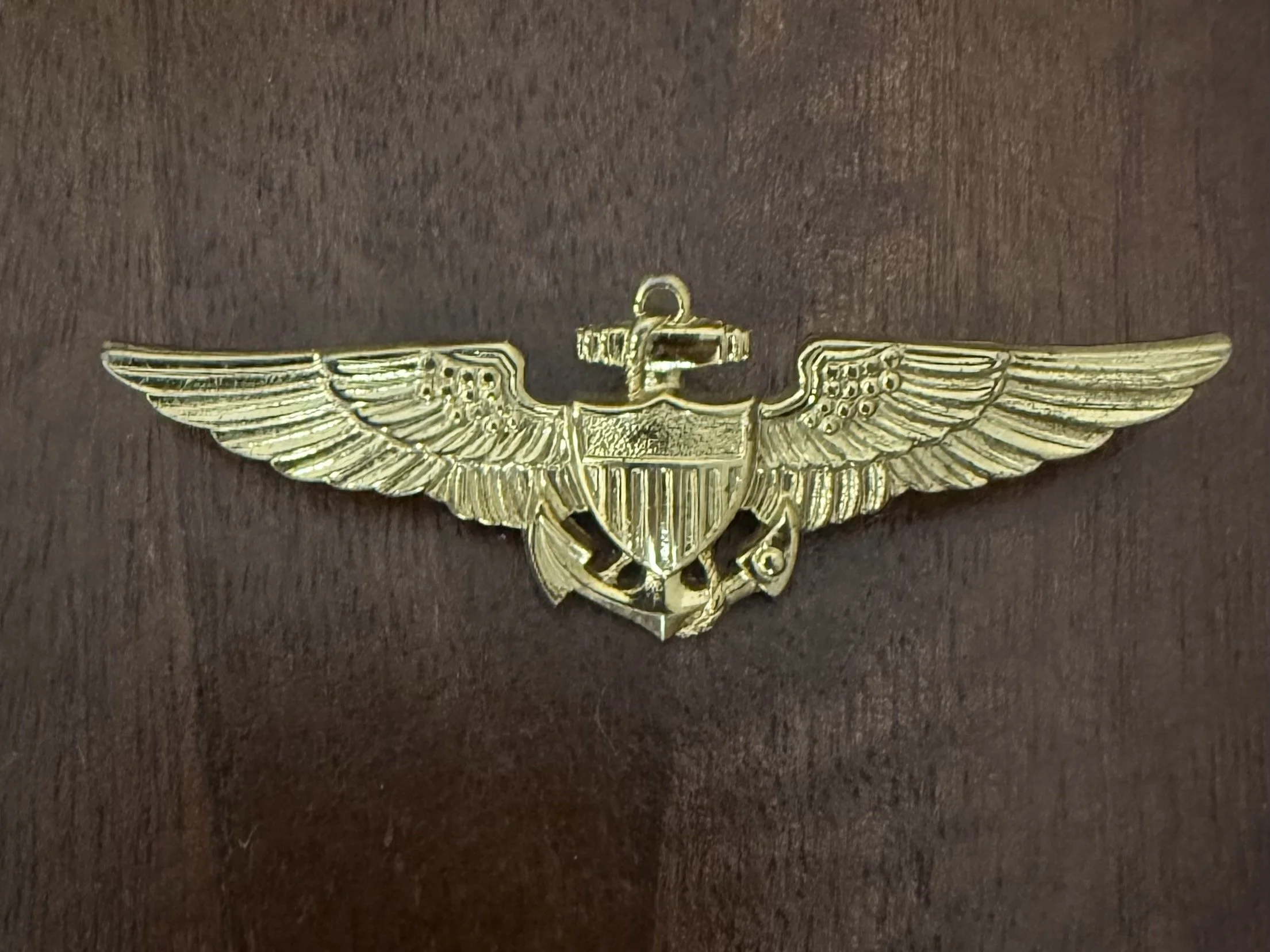
One of the other legendary H-65 branch instructors is a prior Navy pilot. Before coming into the Coast Guard, he instructed at flight school in the T-34. He spends hours with me, giving me advice and explaining the attitude and motivation required to make it through flight training. I can’t believe how generous he is and how much he wants to help me. On my last day in Mobile before heading back to flight training, he presents me with a set of gold naval aviator wings and says, “You are going to have a lot of very hard days in flight school. It is an extremely demanding and challenging time. There will be plenty of hard days where you don’t think you can make it through. Put these wings somewhere on your desk at home where you see them every day. Put them where you will spend hours studying. When it gets tough, look at these wings and remember what you are working toward. I know you will be wearing these wings when you graduate flight school.”
I can’t imagine what it is going to take, but I need to do everything I can to earn those wings.