REPORTING IN DAY
June 28th, 2003
I am perched on a lifeguard tower at Second Beach in Middletown, Rhode Island, staring out at the ocean. My skin is dark, and my hair and lifeguard sweats are bleached from the sun. As I watch beachgoers enjoy the cool Atlantic waters on a beautiful New England summer day, I hear a call on the radio asking me to report to the main lifeguard office.
I climb down the tower and rush through the hot sand. My boss is in the office and hands me the phone. I can’t think of anyone who even has the number of the lifeguard office or why it would be important enough for me to leave the tower. Nervous and confused, I answer.
“Hello?”
“This is Lieutenant Commander Stone from the Coast Guard Academy. Is this George Matthews?”
“Yes, sir.”
“I am calling to let you know that someone broke their leg and cannot report to the Coast Guard Academy as part of the class of 2007. Are you still interested in a last-minute appointment?”
“Yes, sir?”
“Are you able to report on June 30th?”
“Yes, sir.”
“Outstanding. Be there at 0800 on June 30th in business casual. I will send the rest of the details in an email. Congratulations, and welcome to the class of 2007.”
My boss is smiling. I tell him I need to quit and have someone cover the rest of my shifts because I am reporting to the Coast Guard Academy in two days. He congratulates me, and I run out the door to tell all my friends. Everyone is happy for me. I have spent the past three years sitting with them on the tower and sharing my dream of being a Coast Guard pilot.
I am excited but terrified. Two days is not much time to prepare for the rest of my life. Fortunately, when you attend military school, the packing list is short: toiletries, socks, underwear, and white V-neck undershirts. The next few days are a blur as I enjoy the last of my summer break, living at home, hanging out with my high school sweetheart and best friends, and being a child.
You would think that I am excited as I pull through the gate at the Coast Guard Academy, eager to start my military career and live my dream.
I am not.
I’m not ready. Deep down, I know it, but there is no turning back.
We pull up to the quad at the Chase Hall barracks. I say goodbye to my family and girlfriend and put on my bravest face as I walk up to intake. I am wearing a long-sleeved blue dress shirt, a nice pair of khaki pants, and brown dress shoes as I approach one of the uniformed cadre.
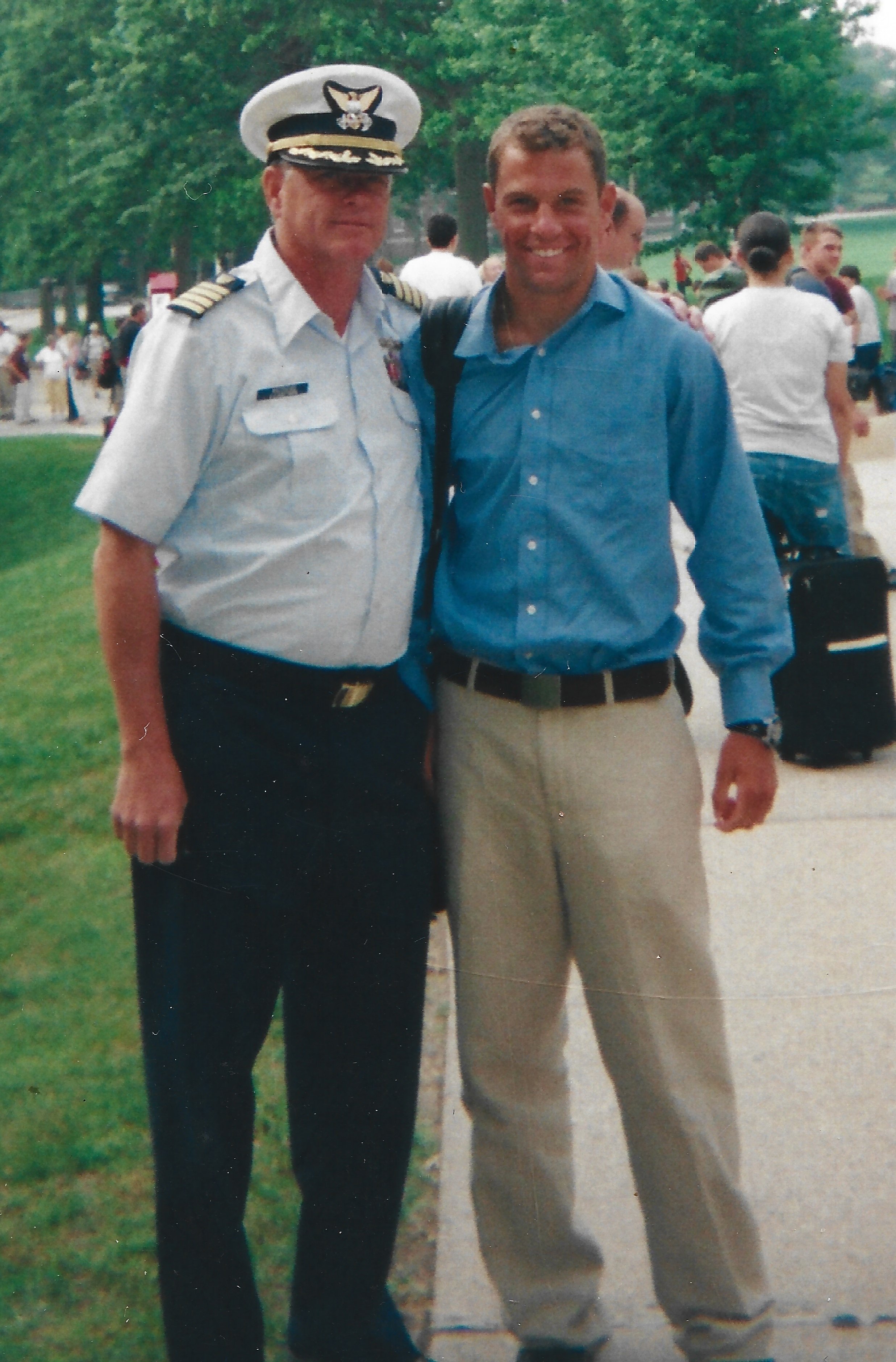
She asks me for my blue folder, and at that moment, I realize I am in trouble. I tell her I don’t have one, and as I look around, I notice something terrifying. Every single person reporting in that day is wearing gym gear and running shoes and carrying a blue folder.
I try to explain to the cadre that I was given a last-minute appointment and found out two days ago that I would be reporting in. I have no folder, and I don’t know what the contents of this folder are, but it seems important. She goes to get another cadre, and I explain my situation several times. Eventually, the cadre sort it out. I am told to roll up the sleeves of my freshly pressed blue dress shirt, and she writes numbers on each of my forearms in permanent marker.
The cadre line us up in formation, and we wait a few minutes for everyone to check in. Our families stand around, watching proudly as their sons and daughters enjoy their last moments as civilians. We stand nervously in silence before a cadre with lots of flair on his uniform begins yelling and welcomes the class of 2007.
After that, all hell breaks loose, and the cadre surround us while screaming instructions.
It is chaos.
I quickly learn that the worst thing you can do in the military is stand out. Since I showed up dressed like a Chick-fil-A manager, I immediately attract plenty of unwanted attention.
They herd us into Chase Hall, and the first stop is gear issue. I am asked several more times for my blue folder. Everyone has neatly stacked, perfectly sized uniform items that they stuff into their seabags. Blue T-shirts and gray T-shirts all have the Academy seal, “Class of 2007,” and their names printed on them.
I can’t wait to get mine and fit in with the rest of the group, but I have no class shirt since nobody knew I was coming. After more confusion, I am given some other generic Coast Guard Academy shirts. The gray is a few shades off, and none of my shirts have my name or “Class of 2007.” I am given several other uniform items, shoes, a lockbox, and everything else I will need for Swab Summer. I hoist the heavy bag onto my back.
At some point during the mayhem, the cadre teach us several important things: the position of attention, which is the only way we are allowed to stand; how to march and “square corners,” walking right at the wall as if you don’t see it and doing a 90-degree spin at the last minute; and “eyes in the boat,” which means always looking straight ahead. We are no longer allowed to look anywhere else.
We also learn a new way of communicating. We scream at maximum volume, refer to ourselves in the third person, and only have five swab responses: “Yes, sir/ma’am,” “No, sir/ma’am,” “No excuse, sir/ma’am,” “This swab will find out, sir/ma’am,” and “Aye aye, sir/ma’am.” Any infractions are met with a swarm of cadre screaming incoherently at you.
Once everyone has their gear, we are herded in a single-file line deeper into the barracks. Chase Hall routinely tops the Princeton Review’s “Dorms Like Dungeons” category, and it doesn’t take long to see why. There is no air conditioning, no carpet, bare walls, and every room looks like a prison cell.
With everything I own on my back, drenched in sweat, and blisters forming in my dress shoes, we “move with a purpose” up several flights of stairs. Afraid to look anywhere but straight ahead, I trip at least fifteen times.
When we get to our floor, we are told, “The number on your right arm is your room number. You have two minutes to go into your room, drop off your seabag, and return to the bulkhead outside your room in your gray gym shirt, blue shorts, and running shoes.”
More chaos.
Within a few seconds, everyone is in their rooms with closed doors. I am in a panic, running back and forth down the length of the barracks. Since everyone else has found their room, I get the full attention of all the cadre, who run beside me in a screaming cacophony. I am berated whenever I attempt to move my eyes left and right to read room numbers.
I have sweat entirely through my Chick-fil-A manager outfit and feel like I could have a heart attack at any second. My feet are now covered in blisters, and I curse the officer who told me to wear business casual. I am constantly made aware of the rapidly approaching time limit and make no progress as I start my third trip down the long hallway.
Most people are already on the bulkhead in their uniforms, enjoying a break from the screaming while all the cadre are focused on me. Eventually, a cadre tells me to stop. She looks at my arm, while the other cadre critique my position of attention, and she realizes the number on my arm does not correlate to any room in Chase Hall.
“Where is your blue folder?”
“No excuse, ma’am.”
“Okay, but really, where is it? We need to figure out your room number.”
“Swab Matthews was never given one. Swab Matthews found out he was coming to the Coast Guard Academy two days ago.”
She tells me to go to some random room and change while they figure it out. Several minutes after the time expires, I emerge with my off-color gray shirt already soaked in sweat. Over the next couple of hours, I get my head shaved, we learn how to march in formation and how to prep our uniforms, and we mostly run around while getting screamed at.
In the afternoon, we are given another unrealistic timeline and told to shower and dress in our working blue pants, tropical blue shirt with our name tags, running shoes, and “Class of 2007” ball cap. Of course, everyone has a blue plastic name tag with their last name and “U.S. Coast Guard” engraved on it.
Everyone but me.
At least I have a room at this point.
I shower, change into my uniform, and stand on the bulkhead. There is another barrage of questions about why I want to be different and not wear a name tag.
“No excuse, sir.”
“Go in your room and get it.”
“Swab Matthews doesn’t have one.”
“Why not?”
“Swab Matthews was never given one. Swab Matthews found out he was coming to the Coast Guard Academy two days ago.”
We run out of time to discuss this as we march onto the parade field. During the short transit, several more cadre stop me to point out my uniform discrepancy. We all march onto the parade field, having recently learned how to march in formation, and form up in front of our parents. We stand proudly on the historic parade field to be sworn in. At this moment, we raise our right hands and take the oath of office, leaving our lives as civilians and becoming members of the United States Coast Guard.
I have always dreamed of this moment, when I would become part of the world’s most impressive military and earn the title of service member, but sadly, I hardly remember it. I am just happy to have a couple of seconds when I am not getting screamed at or explaining my various uniform discrepancies. The significance of the moment is completely lost on me. After swearing in, we climb up on some bleachers and take our official class of 2007 photo before being released for a few minutes to say goodbye to our families one last time.
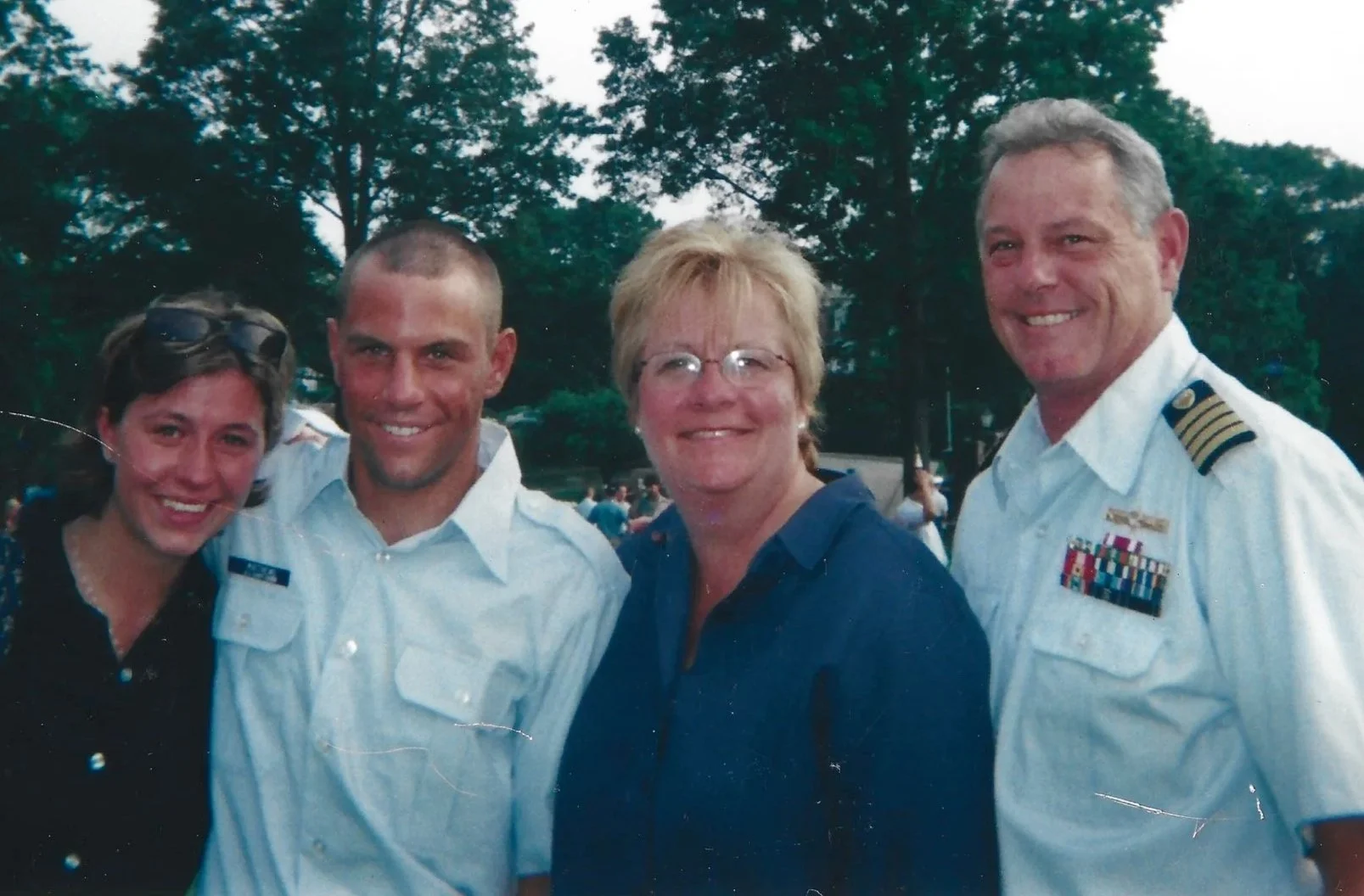
In a strange coincidence, June 30th is my father’s last official day in the Coast Guard, and he attends my swearing-in ceremony wearing his uniform for the last time in his career. Although I barely remember my actual swearing-in, I will never forget the next moment. My father immediately notices I don’t have a name tag, takes his off, and gives it to me. I have watched him come home in that uniform my whole life, and I have always admired him for his service to our country. Now, as he gives me his name tag, I know it is my turn, and I swell with pride, trying to hold back tears. My girlfriend and family all say their goodbyes, and a few moments later, we march back into the barracks.
Despite my legacy name tag and a renewed sense of pride, I won’t last long.